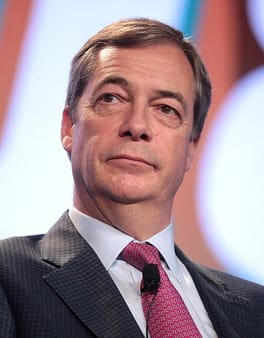
Photo: Gage Skidmore from Peoria, AZ, United States of America / CC BY-SA 2.0 (source: Wikimedia Commons)
Nigel Farage was born on April 3, 1964 in Downe, United Kingdom. Nigel Farage is credited as a politician, autobiographer and commodity broker. The age as of 2026 is 62. Education on record includes Dulwich College.
My Take
Nigel Farage is one of the most polarizing figures in modern British politics, and I write about him with that polarization fully in mind. Whatever one thinks of his positions — and opinions could hardly be more divided — his influence is undeniable: a former commodity broker who became the public face of Brexit and reshaped the United Kingdom's political map. As an observer, what interests me is his skill as a communicator; he reads the public mood with unusual sharpness and thrives on broadcast media. I will leave the policy verdicts to voters and historians, but as a case study in how rhetoric moves nations, he is essential to understand.
This take was written by generative AI, one per person, from publicly reported facts (editorial policy). It is a reading of the record, not reporting.
1. Profile
- Name (English)
- Nigel Farage
- Name (Japanese)
- ナイジェル・ファラージ
- Reading
- ないじぇる・ふぁらーじ
- Born
- April 3, 1964 (age 62)
- Origin
- Downe, United Kingdom
- Occupation
- politician / autobiographer / commodity broker / spokesperson / broadcaster
- Zodiac / Chinese zodiac
- Aries / Dragon
2. Background
- University
- Dulwich College
3. Links
- Official sitehttps://nfarage.com
- Instagramhttps://www.instagram.com/nigel_farage/
- Xhttps://x.com/Nigel_Farage
- Wikipedia (English)https://en.wikipedia.org/wiki/Nigel%20Farage
- Wikipedia (Japanese)https://ja.wikipedia.org/wiki/%E3%83%8A%E3%82%A4%E3%82%B8%E3%82%A7%E3%83%AB%E3%83%BB%E3%83%95%E3%82%A1%E3%83%A9%E3%83%BC%E3%82%B8
- Wikidatahttps://www.wikidata.org/wiki/Q318471
4. About this entry
Tags
- Last updated
Facts are limited to publicly available information up to 2024; non-public or unconfirmed items are omitted. English text is machine-assisted (facts translated by Sonnet, "My Take" written by Opus 4.8). The Japanese page is the source of record.
Frequently asked questions
When was Nigel Farage born?
Born April 3, 1964 (age 62).
Where is Nigel Farage from?
Nigel Farage is from Downe, United Kingdom.
What does Nigel Farage do?
Nigel Farage works as politician, autobiographer, commodity broker, spokesperson, broadcaster.
Politician — see all → · Autobiographer — see all → · More people from the United Kingdom →