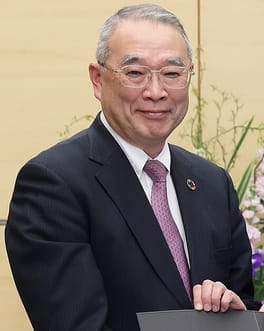
Photo: 首相官邸 / CC BY 4.0 (source: Wikimedia Commons)
My Take
Nobuhiro Endo is the kind of person who makes you quietly rethink what "impressive" actually means. Born in 1953 in Oiso, one of those relaxed, salt-aired towns along the Shonan coast in Kanagawa, he made his way to Tokyo Institute of Technology — which, if you know anything about Japanese engineering education, is about as serious as it gets. Electrical engineering isn't glamorous, but it's the invisible backbone of basically everything we take for granted, and people who dedicate a career to it deserve more credit than they usually get. He went on to run NEC as president and chairman, and the shape of it — coastal upbringing, rigorous schooling, a technical career that reached the top of the company — reads like someone who built things slowly and well. Respect.
This take was written by generative AI, one per person, from publicly reported facts (editorial policy). It is a reading of the record, not reporting.
Overview
Nobuhiro Endō is a Japanese electrical engineer born on November 8, 1953, in Oiso, Kanagawa Prefecture. He studied at Tokyo Institute of Technology, where he pursued electrical engineering. After earning a doctorate in engineering there, he joined NEC, rising to president and later chairman, and served as vice chairman of Keidanren.
1. Profile
- Name (English)
- Nobuhiro Endō
- Name (Japanese)
- 遠藤信博
- Reading
- えんどう のぶひろ
- Born
- November 8, 1953 (age 72)
- Origin
- Oiso, Kanagawa Prefecture, Japan
- Occupation
- Businessperson / Electrical engineer
- Zodiac / Chinese zodiac
- Scorpio / Snake
2. Background
- University
- Tokyo Institute of Technology
3. Links
- Wikipedia (Japanese)https://ja.wikipedia.org/wiki/%E9%81%A0%E8%97%A4%E4%BF%A1%E5%8D%9A
- Wikidatahttps://www.wikidata.org/wiki/Q43426123
4. About this entry
Tags
- Last updated
Only publicly available facts are listed; non-public or unconfirmed items are omitted. Base data was compiled from Wikidata from June 2026 onward; ages are recalculated daily and deaths are checked against Wikidata on an ongoing basis. English text is machine-assisted (facts translated by Sonnet, "My Take" written by Opus 4.8). The Japanese page is the source of record.
Frequently asked questions
When was Nobuhiro Endō born?
Nobuhiro Endō was born on November 8, 1953 and is 72 years old.
Where is Nobuhiro Endō from?
Nobuhiro Endō is from Oiso, Kanagawa Prefecture, Japan.
What does Nobuhiro Endō do?
Nobuhiro Endō works as Businessperson, Electrical engineer.
Where did Nobuhiro Endō study?
Nobuhiro Endō attended Tokyo Institute of Technology.
Businessperson — see all → · More people from Japan → · More people born on November 8 →