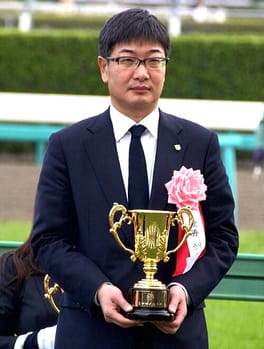
Photo: nakashi / CC BY-SA 2.0 (source: Wikimedia Commons)
My Take
Honestly, Noriyuki Hori is one of those figures whose record says more than any profile could. He quit an accounting job to start over as a stable hand, got his trainer's licence in 2002, and has since sent out champions like Maurice and Duramente — and he's still doing it in his late fifties, which feels less like luck and more like a deliberate choice. I get the sense this is a guy who earns his credibility quietly, lets the accumulated work do the talking, and genuinely doesn't need the spotlight to feel settled in what he does. Respect for that kind of self-possession.
This take was written by generative AI, one per person, from publicly reported facts (editorial policy). It is a reading of the record, not reporting.
Overview
Noriyuki Hori is a Japanese racehorse trainer based at the JRA's Miho Training Center, born on November 9, 1967, in Ichikawa, Chiba Prefecture, Japan. He is a Scorpio by zodiac sign and belongs to the Year of the Goat in the Chinese zodiac. He first worked with horses in a part-time job at Nakayama Racecourse while studying at Nihon University, became a licensed trainer in 2002, and has trained horses including Maurice, Duramente, Satono Crown and Tastiera.
1. Profile
- Name (English)
- Noriyuki Hori
- Name (Japanese)
- 堀宣行
- Reading
- ほり のりゆき
- Born
- November 9, 1967 (age 58)
- Origin
- Ichikawa, Chiba Prefecture, Japan
- Occupation
- Horse Trainer
- Zodiac / Chinese zodiac
- Scorpio / Goat
2. Links
- Wikipedia (Japanese)https://ja.wikipedia.org/wiki/%E5%A0%80%E5%AE%A3%E8%A1%8C
- Wikidatahttps://www.wikidata.org/wiki/Q11427391
3. About this entry
Tags
- Last updated
Only publicly available facts are listed; non-public or unconfirmed items are omitted. Base data was compiled from Wikidata from June 2026 onward; ages are recalculated daily and deaths are checked against Wikidata on an ongoing basis. English text is machine-assisted (facts translated by Sonnet, "My Take" written by Opus 4.8). The Japanese page is the source of record.
Frequently asked questions
When was Noriyuki Hori born?
Noriyuki Hori was born on November 9, 1967 and is 58 years old.
Where is Noriyuki Hori from?
Noriyuki Hori is from Ichikawa, Chiba Prefecture, Japan.
What does Noriyuki Hori do?
Noriyuki Hori works as Horse Trainer.
Horse Trainer — see all → · More people from Japan → · More people born on November 9 →