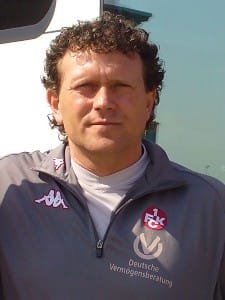
Photo: StefanW-co / CC BY-SA 3.0 (source: Wikimedia Commons)
Public records list Olaf Marschall as an association football player and association football coach. Olaf Marschall was born in Torgau, Saxony, Germany on March 19, 1966. That works out to 60 years old in 2026. The listed height is 186 cm.
My Take
Olaf Marschall's career reads like a map of a continent in upheaval. Born in Torgau, he came up through Lokomotive Leipzig in the old East German top flight, reached a Cup Winners' Cup final, detoured through Austria, landed at Dynamo Dresden, and finally lifted the Bundesliga title with Kaiserslautern in 1998. A 186 cm forward chasing goals across that shifting landscape isn't just an individual story, it's the reunification era in miniature. What I appreciate most is the turn to coaching afterward. A striker spends his playing days being selfish near goal, then chooses to hand the craft forward. That arc earns my respect.
This take was written by generative AI, one per person, from publicly reported facts (editorial policy). It is a reading of the record, not reporting.
1. Profile
- Name (English)
- Olaf Marschall
- Name (Japanese)
- オラフ・マーシャル
- Reading
- おらふ・まーしゃる
- Born
- March 19, 1966 (age 60)
- Origin
- Torgau, Saxony, Germany
- Height
- 186 cm
- Occupation
- association football player / association football coach
- Zodiac / Chinese zodiac
- Pisces / Horse
2. Links
3. About this entry
Tags
- Last updated
Facts are limited to publicly available information up to 2024; non-public or unconfirmed items are omitted. English text is machine-assisted (facts translated by Sonnet, "My Take" written by Opus 4.8). The Japanese page is the source of record.
Frequently asked questions
When was Olaf Marschall born?
Born March 19, 1966 (age 60).
Where is Olaf Marschall from?
Olaf Marschall is from Torgau, Saxony, Germany.
What does Olaf Marschall do?
Olaf Marschall works as association football player, association football coach.
How tall is Olaf Marschall?
Olaf Marschall is 186 cm.
Association football player — see all → · Association football coach — see all → · More people from Germany →