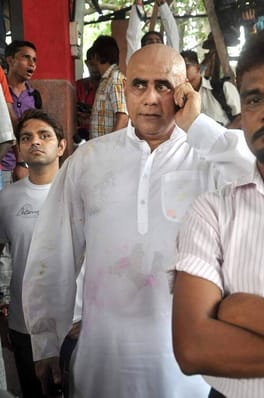
Photo: Bollywood Hungama / CC BY 3.0 (source: Wikimedia Commons)
Puneet Issar was born on November 6, 1959 in Punjab, India. Public records list Puneet Issar as a film director, screenwriter and television actor. That works out to 66 years old in 2026.
My Take
Puneet Issar is the kind of character actor I deeply admire. Starting as a villain in the 1983 film Coolie, he found lasting fame as Duryodhana in the landmark television Mahabharat, a role demanding the gravitas to anchor an entire epic. What interests me most is his range: actor, writer, director, producer and dialect coach. That breadth signals a craftsman who understands storytelling from every angle, not just the spotlight. Playing a mythological antagonist convincingly takes both technique and nerve, and he made Duryodhana unforgettable for a generation. I value performers who serve the story over their own vanity, and Issar strikes me as exactly that.
This take was written by generative AI, one per person, from publicly reported facts (editorial policy). It is a reading of the record, not reporting.
1. Profile
- Name (English)
- Puneet Issar
- Name (Japanese)
- プニート・イッサル
- Reading
- ぷにーと・いっさる
- Born
- November 6, 1959 (age 66)
- Origin
- Punjab, India
- Occupation
- film director / actor / screenwriter / television actor
- Zodiac / Chinese zodiac
- Scorpio / Boar
2. Links
- Xhttps://x.com/ImPuneetIssar
- Wikipedia (English)https://en.wikipedia.org/wiki/Puneet%20Issar
- Wikidatahttps://www.wikidata.org/wiki/Q7260123
3. About this entry
Tags
- Last updated
Facts are limited to publicly available information up to 2024; non-public or unconfirmed items are omitted. English text is machine-assisted (facts translated by Sonnet, "My Take" written by Opus 4.8). The Japanese page is the source of record.
Frequently asked questions
When was Puneet Issar born?
Puneet Issar was born on November 6, 1959 and is 66 years old.
Where is Puneet Issar from?
Puneet Issar is from Punjab, India.
What does Puneet Issar do?
Puneet Issar works as film director, actor, screenwriter, television actor.
Film director — see all → · Actor — see all → · More people from India → · More people born on November 6 →