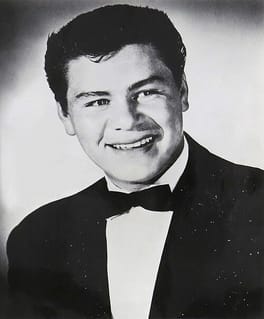
Photo: Distributed by General Artists Corportation / Public domain (source: Wikimedia Commons)
Ritchie Valens was born on May 13, 1941 in Pacoima, California, United States. Ritchie Valens was credited as a singer, singer-songwriter and composer. Death is recorded on February 3, 1959, at the age of 17. Schooling on record includes San Fernando High School. Awards on record include Grammy Hall of Fame (1999), star on Hollywood Walk of Fame, Rock and Roll Hall of Fame (2001) and 1 more.
My Take
Ritchie Valens had barely turned 17 when he recorded La Bamba, and I still can't wrap my head around how a teenager from Pacoima took a centuries-old Mexican folk song and turned it into one of the defining rock and roll moments of the 1950s. He was only in the spotlight for about eight months before that plane crash in February 1959 took him, Buddy Holly, and The Big Bopper — and yet the impact he left behind earned him the Rock and Roll Hall of Fame in 2001 and a Grammy Hall of Fame induction in 1999. What gets me is that he was a Chicano kid at a time when Latin artists had almost zero mainstream footing, and he just broke through anyway on pure talent and charisma. The 1987 biopic starring Lou Diamond Phillips introduced him to a whole new generation, but nothing beats going back to the original recordings and hearing that raw, joyful energy for yourself.
This take was written by generative AI, one per person, from publicly reported facts (editorial policy). It is a reading of the record, not reporting.
1. Profile
- Name (English)
- Ritchie Valens
- Name (Japanese)
- リッチー・ヴァレンス
- Reading
- りっちー・ゔぁれんす
- Born
- May 13, 1941 – February 3, 1959
- Origin
- Pacoima, California, United States
- Occupation
- singer / singer-songwriter / composer / guitarist / songwriter
- Zodiac / Chinese zodiac
- Taurus / Snake
2. Background
- High school
- San Fernando High School
Awards & achievements
- 1999 Grammy Hall of Fame
- star on Hollywood Walk of Fame
- 2001 Rock and Roll Hall of Fame
- 2013 Latin Grammy Hall of Fame
3. Links
- Official sitehttps://www.ritchievalens.com/
- Wikipedia (English)https://en.wikipedia.org/wiki/Ritchie%20Valens
- Wikipedia (Japanese)https://ja.wikipedia.org/wiki/%E3%83%AA%E3%83%83%E3%83%81%E3%83%BC%E3%83%BB%E3%83%B4%E3%82%A1%E3%83%AC%E3%83%B3%E3%82%B9
- Wikidatahttps://www.wikidata.org/wiki/Q309725
4. About this entry
Tags
- Last updated
Only publicly available facts are listed; non-public or unconfirmed items are omitted. Base data was compiled from Wikidata from June 2026 onward; ages are recalculated daily and deaths are checked against Wikidata on an ongoing basis. English text is machine-assisted (facts translated by Sonnet, "My Take" written by Opus 4.8). The Japanese page is the source of record.
Frequently asked questions
When was Ritchie Valens born?
Ritchie Valens was born on May 13, 1941.
When did Ritchie Valens die?
Ritchie Valens died on February 3, 1959, aged 17.
Where was Ritchie Valens from?
Ritchie Valens was from Pacoima, California, United States.
What did Ritchie Valens do?
Ritchie Valens worked as singer, singer-songwriter, composer, guitarist, songwriter.
Which high school did Ritchie Valens attend?
Ritchie Valens attended San Fernando High School.
Singer — see all → · Singer-songwriter — see all → · More people from the United States → · More people born on May 13 →