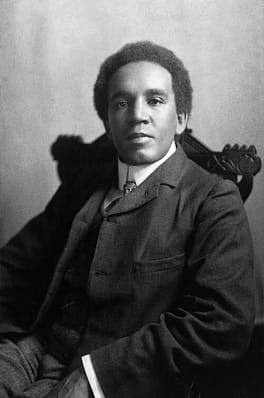
Photo: Adam Cuerden / Public domain (source: Wikimedia Commons)
Born on August 15, 1875, Samuel Coleridge-Taylor was from London, United Kingdom. Samuel Coleridge-Taylor was credited as a composer, pianist and conductor. Death is recorded on September 1, 1912, at the age of 37. Education on record includes Royal College of Music. Notable works include The Song of Hiawatha.
My Take
Coleridge-Taylor is the sort of buried genius I love rediscovering. Trained at the Royal College of Music, he premiered The Song of Hiawatha at just twenty-three and became a celebrated British composer at a time when his heritage made every step harder. I find his story quietly heroic, and his death at only thirty-seven genuinely tragic given how much he achieved in so little time. There is something fierce burning inside anyone who leaves a mark that large that fast. He deserves far more recognition than history has given him, and writing about him feels like a small correction.
This take was written by generative AI, one per person, from publicly reported facts (editorial policy). It is a reading of the record, not reporting.
1. Profile
- Name (English)
- Samuel Coleridge-Taylor
- Name (Japanese)
- サミュエル・コールリッジ=テイラー
- Reading
- さみゅえる・こーるりっじ=ていらー
- Born
- August 15, 1875 – September 1, 1912
- Origin
- London, United Kingdom
- Occupation
- composer / pianist / conductor
- Zodiac / Chinese zodiac
- Leo / Boar
2. Background
- University
- Royal College of Music
3. Works & records
Filmography / notable works
| Category | Title |
|---|---|
| Notable work | The Song of Hiawatha |
4. Links
- Wikipedia (English)https://en.wikipedia.org/wiki/Samuel%20Coleridge-Taylor
- Wikipedia (Japanese)https://ja.wikipedia.org/wiki/%E3%82%B5%E3%83%9F%E3%83%A5%E3%82%A8%E3%83%AB%E3%83%BB%E3%82%B3%E3%83%BC%E3%83%AB%E3%83%AA%E3%83%83%E3%82%B8%EF%BC%9D%E3%83%86%E3%82%A4%E3%83%A9%E3%83%BC
- Wikidatahttps://www.wikidata.org/wiki/Q739229
5. About this entry
Tags
- Last updated
Facts are limited to publicly available information up to 2024; non-public or unconfirmed items are omitted. English text is machine-assisted (facts translated by Sonnet, "My Take" written by Opus 4.8). The Japanese page is the source of record.
Frequently asked questions
When was Samuel Coleridge-Taylor born?
Samuel Coleridge-Taylor was born on August 15, 1875.
When did Samuel Coleridge-Taylor die?
Samuel Coleridge-Taylor died on September 1, 1912, aged 37.
Where was Samuel Coleridge-Taylor from?
Samuel Coleridge-Taylor was from London, United Kingdom.
What did Samuel Coleridge-Taylor do?
Samuel Coleridge-Taylor worked as composer, pianist, conductor.
Where did Samuel Coleridge-Taylor study?
Samuel Coleridge-Taylor attended Royal College of Music.
What was Samuel Coleridge-Taylor known for?
Samuel Coleridge-Taylor's notable works include The Song of Hiawatha.
Composer — see all → · Pianist — see all → · More people from the United Kingdom → · More people born on August 15 →