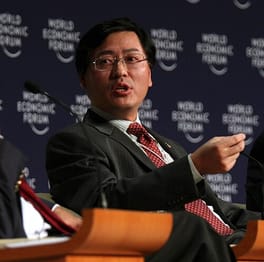
Photo: Natalie Behring, World Economic Forum / CC BY-SA 2.0 (source: Wikimedia Commons)
Born on November 12, 1964 in Hefei, People's Republic of China, Yang Yuanqing is an entrepreneur and businessperson. As of 2026, Yang Yuanqing is 61 years old. Education on record includes Shanghai Jiao Tong University.
My Take
Yang Yuanqing is, to me, one of the quieter giants of global technology. Born in Hefei in 1964 and educated at Shanghai Jiao Tong University, he rose to become Chairman and CEO of Lenovo, steering a Chinese company into a genuine worldwide powerhouse. I find his arc compelling because it tracks the larger story of China's tech industry going from follower to leader. He is also noted as a philanthropist, which adds texture to the executive image. Compared with louder Silicon Valley founders, Yang strikes me as the kind of steady operator whose impact is easy to underestimate and hard to overstate.
This take was written by generative AI, one per person, from publicly reported facts (editorial policy). It is a reading of the record, not reporting.
1. Profile
- Name (English)
- Yang Yuanqing
- Name (Japanese)
- 楊元慶
- Reading
- よう・げんけい
- Born
- November 12, 1964 (age 61)
- Origin
- Hefei, People's Republic of China
- Occupation
- entrepreneur / businessperson
- Zodiac / Chinese zodiac
- Scorpio / Dragon
2. Background
- University
- Shanghai Jiao Tong University
3. Links
- Wikipedia (English)https://en.wikipedia.org/wiki/Yang%20Yuanqing
- Wikipedia (Japanese)https://ja.wikipedia.org/wiki/%E6%A5%8A%E5%85%83%E6%85%B6
- Wikidatahttps://www.wikidata.org/wiki/Q740364
4. About this entry
Tags
- Last updated
Facts are limited to publicly available information up to 2024; non-public or unconfirmed items are omitted. English text is machine-assisted (facts translated by Sonnet, "My Take" written by Opus 4.8). The Japanese page is the source of record.
Frequently asked questions
When was Yang Yuanqing born?
Born November 12, 1964 (age 61).
Where is Yang Yuanqing from?
Yang Yuanqing is from Hefei, People's Republic of China.
What does Yang Yuanqing do?
Yang Yuanqing works as entrepreneur, businessperson.
Entrepreneur — see all → · Businessperson — see all → · More people from the People's Republic of China →