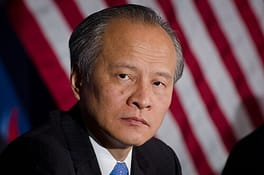
Photo: U.S. Department of Agriculture / CC BY 2.0 (source: Wikimedia Commons)
Cui Tiankai is a politician and diplomat, born on October 1, 1952 in Shanghai, People's Republic of China. That puts Cui Tiankai at 73 years old in 2026. Schooling on record includes East China Normal University.
My Take
Cui Tiankai held one of the hardest diplomatic posts imaginable, and his record as the longest-serving Chinese Ambassador to the United States tells me he was trusted to manage that relationship through genuinely turbulent years. Eight years from 2013 to 2021 spans an era when US-China ties grew sharply more adversarial, so his durability in the role signals real skill at staying steady amid pressure. A Shanghai native educated at East China Normal University, he embodied the polished, career-diplomat archetype Beijing sends to its most sensitive postings. I read his longevity less as comfort and more as evidence he was considered indispensable to a delicate, deteriorating dialogue.
This take was written by generative AI, one per person, from publicly reported facts (editorial policy). It is a reading of the record, not reporting.
1. Profile
- Name (English)
- Cui Tiankai
- Name (Japanese)
- 崔天凱
- Reading
- さい・てんがい
- Born
- October 1, 1952 (age 73)
- Origin
- Shanghai, People's Republic of China
- Occupation
- politician / diplomat
- Zodiac / Chinese zodiac
- Libra / Dragon
2. Background
- University
- East China Normal University
3. Links
- Xhttps://x.com/AmbCuiTiankai
- Wikipedia (English)https://en.wikipedia.org/wiki/Cui%20Tiankai
- Wikipedia (Japanese)https://ja.wikipedia.org/wiki/%E5%B4%94%E5%A4%A9%E5%87%B1
- Wikidatahttps://www.wikidata.org/wiki/Q2213434
4. About this entry
Tags
- Last updated
Facts are limited to publicly available information up to 2024; non-public or unconfirmed items are omitted. English text is machine-assisted (facts translated by Sonnet, "My Take" written by Opus 4.8). The Japanese page is the source of record.
Frequently asked questions
When was Cui Tiankai born?
Born October 1, 1952 (age 73).
Where is Cui Tiankai from?
Cui Tiankai is from Shanghai, People's Republic of China.
What does Cui Tiankai do?
Cui Tiankai works as politician, diplomat.
Politician — see all → · Diplomat — see all → · More people from the People's Republic of China →