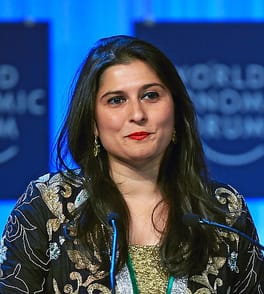
Photo: Sebastian Derungs - World Economic Forum / CC BY-SA 2.0 (source: Wikimedia Commons)
Sharmeen Obaid-Chinoy was born on November 12, 1978 in Karachi, Sindh, Pakistan and is credited as a journalist, film director and film producer. As of 2026, Sharmeen Obaid-Chinoy is 47 years old. Schooling on record includes Stanford University. Awards on record include Hilal-i-Imtiaz, Academy Award for Best Documentary (Short Subject) (2012, 2016), BBC 100 Women (2014) and 1 more.
My Take
Sharmeen Obaid-Chinoy earns my full respect. A Karachi-born Pakistani journalist and filmmaker, Stanford-educated, she turned a camera into a weapon against gender injustice, winning two Academy Awards for short documentaries, seven Emmys, and a place on the BBC 100 Women list. What I value is that her films do not merely record reality; they prick the viewer's conscience and push society to change. Tackling subjects as harrowing as honor killings and acid attacks demands extraordinary nerve. To me, her real gift is amplifying the voices of those least able to speak, and I love filmmakers who wield craft for that purpose.
This take was written by generative AI, one per person, from publicly reported facts (editorial policy). It is a reading of the record, not reporting.
1. Profile
- Name (English)
- Sharmeen Obaid-Chinoy
- Name (Japanese)
- シャーミーン・オベイド=チノイ
- Reading
- しゃーみーん・おべいど=ちのい
- Born
- November 12, 1978 (age 47)
- Origin
- Karachi, Sindh, Pakistan
- Occupation
- journalist / film director / film producer / screenwriter / director
- Zodiac / Chinese zodiac
- Scorpio / Horse
2. Background
- University
- Stanford University
Awards & achievements
- Hilal-i-Imtiaz
- 2012 Academy Award for Best Documentary (Short Subject)
- 2016 Academy Award for Best Documentary (Short Subject)
- 2014 BBC 100 Women
- The Smith College Medal
3. Links
- Official sitehttps://sharmeenobaidfilms.com
- Instagramhttps://www.instagram.com/sharmeenobaidchinoy/
- Wikipedia (English)https://en.wikipedia.org/wiki/Sharmeen%20Obaid-Chinoy
- Wikipedia (Japanese)https://ja.wikipedia.org/wiki/%E3%82%B7%E3%83%A3%E3%83%AB%E3%83%9F%E3%83%BC%E3%83%B3%E3%83%BB%E3%82%AA%E3%83%99%E3%82%A4%E3%83%89%EF%BC%9D%E3%83%81%E3%83%8E%E3%82%A4
- Wikidatahttps://www.wikidata.org/wiki/Q3563826
4. About this entry
Tags
- Last updated
Facts are limited to publicly available information up to 2024; non-public or unconfirmed items are omitted. English text is machine-assisted (facts translated by Sonnet, "My Take" written by Opus 4.8). The Japanese page is the source of record.
Frequently asked questions
When was Sharmeen Obaid-Chinoy born?
Born November 12, 1978 (age 47).
Where is Sharmeen Obaid-Chinoy from?
Sharmeen Obaid-Chinoy is from Karachi, Sindh, Pakistan.
What does Sharmeen Obaid-Chinoy do?
Sharmeen Obaid-Chinoy works as journalist, film director, film producer, screenwriter, director.
Journalist — see all → · Film director — see all → · More people from Pakistan →