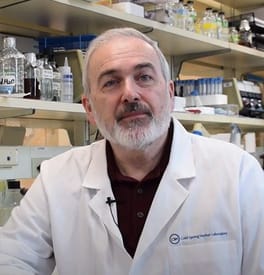
Photo: Cold Spring Harbor Laboratory / CC BY 3.0 (source: Wikimedia Commons)
Adrian Robert Krainer was born on September 14, 1958 in Montevideo, Montevideo Department, Uruguay and is credited as a researcher and neuroscientist. As of 2026, Adrian Robert Krainer is 68 years old. Schooling on record includes Harvard University. Recorded honors include Breakthrough Prize in Life Sciences (2019), Wolf Prize in Medicine (2021) and Gabbay Award (2021).
My Take
Adrian Krainer represents the version of science I respect most: research that ends in someone's life being saved. Born in Montevideo and educated at Harvard, he cracked the puzzle of RNA splicing and turned that fundamental discovery into a real therapy for spinal muscular atrophy. That translation from bench to bedside is extraordinarily rare, and the Breakthrough Prize, Wolf Prize, and Gabbay Award rightly recognize it. What moves me is the trajectory: a young Uruguayan reshaping global medicine from a lab at Cold Spring Harbor. In an era loud with hype, Krainer's quiet, consequential work is the kind that genuinely deserves celebration.
This take was written by generative AI, one per person, from publicly reported facts (editorial policy). It is a reading of the record, not reporting.
1. Profile
- Name (English)
- Adrian Robert Krainer
- Name (Japanese)
- エイドリアン・クレイナー
- Reading
- えいどりあん・くれいなー
- Born
- September 14, 1958 (age 68)
- Origin
- Montevideo, Montevideo Department, Uruguay
- Occupation
- researcher / neuroscientist
- Zodiac / Chinese zodiac
- Virgo / Dog
2. Background
- University
- Harvard University
Awards & achievements
- 2019 Breakthrough Prize in Life Sciences
- 2021 Wolf Prize in Medicine
- 2021 Gabbay Award
3. Links
- Official sitehttps://www.cshl.edu/research/faculty-staff/adrian-r-krainer/
- Wikipedia (English)https://en.wikipedia.org/wiki/Adrian%20Krainer%20(scientist)
- Wikipedia (Japanese)https://ja.wikipedia.org/wiki/%E3%82%A8%E3%82%A4%E3%83%89%E3%83%AA%E3%82%A2%E3%83%B3%E3%83%BB%E3%82%AF%E3%83%AC%E3%82%A4%E3%83%8A%E3%83%BC
- Wikidatahttps://www.wikidata.org/wiki/Q40473018
4. About this entry
Tags
- Last updated
Facts are limited to publicly available information up to 2024; non-public or unconfirmed items are omitted. English text is machine-assisted (facts translated by Sonnet, "My Take" written by Opus 4.8). The Japanese page is the source of record.
Frequently asked questions
When was Adrian Robert Krainer born?
Born September 14, 1958 (age 68).
Where is Adrian Robert Krainer from?
Adrian Robert Krainer is from Montevideo, Montevideo Department, Uruguay.
What does Adrian Robert Krainer do?
Adrian Robert Krainer works as researcher, neuroscientist.