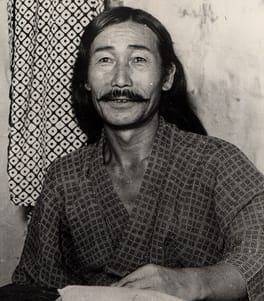
Photo: Unknown author / Public domain (source: Wikimedia Commons)
Public records list Azenbō Soeda as a singer, lyricist and Enka. Azenbō Soeda was born on December 25, 1872 in Kanagawa Prefecture, Japan. Death is recorded on February 8, 1944, at the age of 71.
My Take
Soeda Azenbō is one of those figures who gets filed under "historical curiosity" and then forgotten, which is a genuine shame. Born in Kanagawa in 1872, he was the sharp, restless voice of Meiji-era enka — and I don't mean the weepy ballads you hear today. Back then, enka was street-corner agitprop: a guy with a violin or a shamisen working a crowd, turning political grievances into singable barbs that the authorities couldn't quite ban fast enough. Azenbō was arguably the best of that breed, skewering government hypocrisy and social inequality with a wit that feels surprisingly modern. He lived through the Meiji, Taisho, and early Showa eras and kept at it until his death in 1944. I find him fascinating precisely because he proves that Japan had its own tradition of protest song long before anyone imported the idea from abroad.
This take was written by generative AI, one per person, from publicly reported facts (editorial policy). It is a reading of the record, not reporting.
1. Profile
- Name (English)
- Azenbō Soeda
- Name (Japanese)
- 添田唖蝉坊
- Reading
- そえだ あぜんぼう
- Born
- December 25, 1872 – February 8, 1944
- Origin
- Kanagawa Prefecture, Japan
- Occupation
- singer / lyricist / Enka / composer
- Zodiac / Chinese zodiac
- Capricorn / Monkey
2. Links
- Wikipedia (English)https://en.wikipedia.org/wiki/Soeda%20Azenb%C5%8D
- Wikipedia (Japanese)https://ja.wikipedia.org/wiki/%E6%B7%BB%E7%94%B0%E5%94%96%E8%9D%89%E5%9D%8A
- Wikidatahttps://www.wikidata.org/wiki/Q11560425
3. About this entry
Tags
- Last updated
Only publicly available facts are listed; non-public or unconfirmed items are omitted. Base data was compiled from Wikidata from June 2026 onward; ages are recalculated daily and deaths are checked against Wikidata on an ongoing basis. English text is machine-assisted (facts translated by Sonnet, "My Take" written by Opus 4.8). The Japanese page is the source of record.
Frequently asked questions
When was Azenbō Soeda born?
Azenbō Soeda was born on December 25, 1872.
When did Azenbō Soeda die?
Azenbō Soeda died on February 8, 1944, aged 71.
Where was Azenbō Soeda from?
Azenbō Soeda was from Kanagawa Prefecture, Japan.
What did Azenbō Soeda do?
Azenbō Soeda worked as singer, lyricist, Enka, composer.
Singer — see all → · Lyricist — see all → · More people from Japan → · More people born on December 25 →