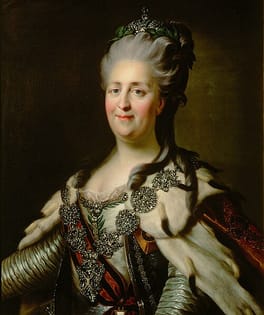
Photo: After Alexander Roslin / Public domain (source: Wikimedia Commons)
Catherine II of Russia was born on May 2, 1729 in Szczecin, West Pomeranian Voivodeship, Kingdom of Prussia and was credited as a politician, monarch and art collector. Catherine II of Russia died on November 17, 1796, aged 67. Listed accolades include Knight of the Order of St. Alexander Nevsky, Order of the White Eagle, Order of the Black Eagle and 5 more. Credited works include Hermitage Museum.
My Take
Catherine the Great is, to me, history's most compelling study in self-invention. A minor German princess with no claim to Russia, she mastered the language, the church, and the court until the empire itself became hers — then ruled for thirty-four years through an age of Enlightenment ferment. Her reign was full of contradictions: progressive correspondence with philosophers alongside hard imperial expansion. What I admire without reservation is her cultural instinct; the collection she built became the Hermitage Museum, a gift that outlived every political controversy. Few rulers understood so clearly that art is the most durable form of power.
This take was written by generative AI, one per person, from publicly reported facts (editorial policy). It is a reading of the record, not reporting.
1. Profile
- Name (English)
- Catherine II of Russia
- Name (Japanese)
- エカチェリーナ2世
- Reading
- えかちぇりーな2世
- Born
- May 2, 1729 – November 17, 1796
- Origin
- Szczecin, West Pomeranian Voivodeship, Kingdom of Prussia
- Occupation
- politician / monarch / art collector / aristocrat
- Zodiac / Chinese zodiac
- Taurus / Rooster
2. Background
Awards & achievements
- Knight of the Order of St. Alexander Nevsky
- Order of the White Eagle
- Order of the Black Eagle
- Order of St. Vladimir, 1st class
- Order of St. Andrew
- Order of Saint Catherine
- Order of St. George
- Order of Saint Anna
3. Works & records
Filmography / notable works
| Category | Title |
|---|---|
| Notable work | Hermitage Museum |
4. Links
5. About this entry
Tags
- Last updated
Facts are limited to publicly available information up to 2024; non-public or unconfirmed items are omitted. English text is machine-assisted (facts translated by Sonnet, "My Take" written by Opus 4.8). The Japanese page is the source of record.
Frequently asked questions
When was Catherine II of Russia born?
Born May 2, 1729.
When did Catherine II of Russia die?
Died November 17, 1796, aged 67.
Where was Catherine II of Russia from?
Catherine II of Russia was from Szczecin, West Pomeranian Voivodeship, Kingdom of Prussia.
What did Catherine II of Russia do?
Catherine II of Russia worked as politician, monarch, art collector, aristocrat.
What was Catherine II of Russia known for?
Notable works include Hermitage Museum.