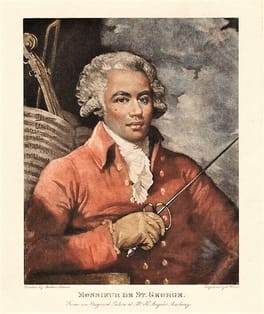
Photo: Mather Brown, William Ward / Public domain (source: Wikimedia Commons)
Public records list Chevalier de Saint-Georges as a composer, conductor and fencer. Born on December 25, 1745, Chevalier de Saint-Georges was from Baillif, France. Death is recorded on June 10, 1799, at the age of 53. Notable works include Nous sommes donc trois ? ou le Provincial à Paris.
My Take
Joseph Bologne, the Chevalier de Saint-Georges, is one of history's most astonishing résumés: violinist, conductor, composer, champion fencer, and soldier, all as a biracial free man of color in 18th-century France. I keep coming back to how thoroughly he was nearly erased from the canon. The fact that we're rediscovering his music now feels less like trivia and more like correcting an old injustice. To me he isn't a footnote to Mozart's era; he's proof of how much talent gets sidelined by prejudice. I genuinely wish more of his work had survived intact.
This take was written by generative AI, one per person, from publicly reported facts (editorial policy). It is a reading of the record, not reporting.
1. Profile
- Name (English)
- Chevalier de Saint-Georges
- Name (Japanese)
- ジョゼフ・ブローニュ・シュヴァリエ・ド・サン=ジョルジュ
- Reading
- じょぜふ・ぶろーにゅ・しゅゔぁりえ・ど・さん=じょるじゅ
- Born
- December 25, 1745 – June 10, 1799
- Origin
- Baillif, France
- Occupation
- composer / conductor / fencer / concertmaster / military personnel
- Zodiac / Chinese zodiac
- Capricorn / Ox
2. Works & records
Filmography / notable works
| Category | Title |
|---|---|
| Notable work | Nous sommes donc trois ? ou le Provincial à Paris |
3. Links
- Wikipedia (English)https://en.wikipedia.org/wiki/Chevalier%20de%20Saint-Georges
- Wikipedia (Japanese)https://ja.wikipedia.org/wiki/%E3%82%B8%E3%83%A7%E3%82%BC%E3%83%95%E3%83%BB%E3%83%96%E3%83%AD%E3%83%BC%E3%83%8B%E3%83%A5%E3%83%BB%E3%82%B7%E3%83%A5%E3%83%B4%E3%82%A1%E3%83%AA%E3%82%A8%E3%83%BB%E3%83%89%E3%83%BB%E3%82%B5%E3%83%B3%EF%BC%9D%E3%82%B8%E3%83%A7%E3%83%AB%E3%82%B8%E3%83%A5
- Wikidatahttps://www.wikidata.org/wiki/Q726953
4. About this entry
Tags
- Last updated
Facts are limited to publicly available information up to 2024; non-public or unconfirmed items are omitted. English text is machine-assisted (facts translated by Sonnet, "My Take" written by Opus 4.8). The Japanese page is the source of record.
Frequently asked questions
When was Chevalier de Saint-Georges born?
Born December 25, 1745.
When did Chevalier de Saint-Georges die?
Died June 10, 1799, aged 53.
Where was Chevalier de Saint-Georges from?
Chevalier de Saint-Georges was from Baillif, France.
What did Chevalier de Saint-Georges do?
Chevalier de Saint-Georges worked as composer, conductor, fencer, concertmaster, military personnel.
What was Chevalier de Saint-Georges known for?
Notable works include Nous sommes donc trois ? ou le Provincial à Paris.
Composer — see all → · Conductor — see all → · More people from France →