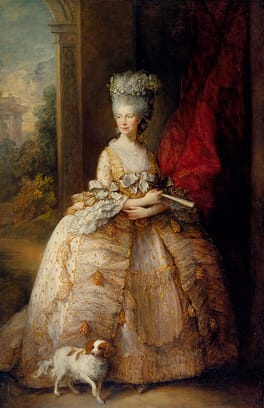
Photo: Thomas Gainsborough / Public domain (source: Wikimedia Commons)
Charlotte of Mecklenburg-Strelitz was credited as an art collector, consort and aristocrat. Charlotte of Mecklenburg-Strelitz was born on May 19, 1744 in Mirow, Mecklenburg-Vorpommern, Germany. Death is recorded on November 17, 1818, at the age of 74.
My Take
Queen Charlotte is one of those historical figures I keep returning to. She arrived in Britain at seventeen, a minor German princess expected mainly to produce heirs, yet she quietly became one of her era's great cultural patrons — collecting art, championing botany, encouraging musicians like the young Mozart. What moves me most is the later chapter: decades spent beside a husband descending into illness, holding a household and a public role together. History often reduces consorts to footnotes, but I see in Charlotte a study in endurance and taste, a woman who turned a constrained position into lasting cultural influence.
This take was written by generative AI, one per person, from publicly reported facts (editorial policy). It is a reading of the record, not reporting.
1. Profile
- Name (English)
- Charlotte of Mecklenburg-Strelitz
- Name (Japanese)
- シャーロット・オブ・メクレンバーグ=ストレリッツ
- Reading
- しゃーろっと・おぶ・めくれんばーぐ=すとれりっつ
- Born
- May 19, 1744 – November 17, 1818
- Origin
- Mirow, Mecklenburg-Vorpommern, Germany
- Occupation
- art collector / consort / aristocrat / artist / politician
- Zodiac / Chinese zodiac
- Taurus / Rat
2. Links
- Wikipedia (English)https://en.wikipedia.org/wiki/Charlotte%20of%20Mecklenburg-Strelitz
- Wikipedia (Japanese)https://ja.wikipedia.org/wiki/%E3%82%B7%E3%83%A3%E3%83%BC%E3%83%AD%E3%83%83%E3%83%88%E3%83%BB%E3%82%AA%E3%83%96%E3%83%BB%E3%83%A1%E3%82%AF%E3%83%AC%E3%83%B3%E3%83%90%E3%83%BC%E3%82%B0%EF%BC%9D%E3%82%B9%E3%83%88%E3%83%AC%E3%83%AA%E3%83%83%E3%83%84
- Wikidatahttps://www.wikidata.org/wiki/Q161159
3. About this entry
Tags
- Last updated
Facts are limited to publicly available information up to 2024; non-public or unconfirmed items are omitted. English text is machine-assisted (facts translated by Sonnet, "My Take" written by Opus 4.8). The Japanese page is the source of record.
Frequently asked questions
When was Charlotte of Mecklenburg-Strelitz born?
Born May 19, 1744.
When did Charlotte of Mecklenburg-Strelitz die?
Died November 17, 1818, aged 74.
Where was Charlotte of Mecklenburg-Strelitz from?
Charlotte of Mecklenburg-Strelitz was from Mirow, Mecklenburg-Vorpommern, Germany.
What did Charlotte of Mecklenburg-Strelitz do?
Charlotte of Mecklenburg-Strelitz worked as art collector, consort, aristocrat, artist, politician.