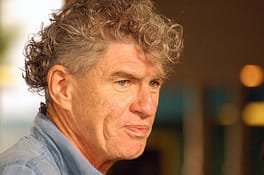
Photo: Unknown author / CC BY-SA 3.0 (source: Wikimedia Commons)
Born on May 2, 1952 in Sydney, New South Wales, Australia, Christopher Doyle is a film director, cinematographer and film actor. That puts Christopher Doyle at 74 years old in 2026. Education on record includes The Chinese University of Hong Kong. Awards on record include Tatler Most Influential Hong Kong (2021).
My Take
Christopher Doyle is genuinely one of those rare figures where you can't separate the person from the feeling they create — watch In the Mood for Love or Chungking Express and you immediately know it's his eye behind the lens, that lush, slightly smeared color palette and those slow-motion moments that somehow feel more real than real life. A Sydney boy who ended up in Hong Kong, learned Cantonese, studied at the Chinese University of Hong Kong, and basically became the visual conscience of an entire era of arthouse cinema — that's a career arc you couldn't script. His collaboration with Wong Kar-wai in the 1990s and 2000s redefined what cinematography could emotionally accomplish, and honestly I think he's underappreciated outside film circles. The guy shoots light like other people breathe.
This take was written by generative AI, one per person, from publicly reported facts (editorial policy). It is a reading of the record, not reporting.
1. Profile
- Name (English)
- Christopher Doyle
- Name (Japanese)
- クリストファー・ドイル
- Reading
- くりすとふぁー・どいる
- Born
- May 2, 1952 (age 74)
- Origin
- Sydney, New South Wales, Australia
- Occupation
- film director / cinematographer / actor / film actor / television actor
- Zodiac / Chinese zodiac
- Taurus / Dragon
2. Background
- University
- The Chinese University of Hong Kong
Awards & achievements
- 2021 Tatler Most Influential Hong Kong
3. Links
4. About this entry
Tags
- Last updated
Only publicly available facts are listed; non-public or unconfirmed items are omitted. Base data was compiled from Wikidata from June 2026 onward; ages are recalculated daily and deaths are checked against Wikidata on an ongoing basis. English text is machine-assisted (facts translated by Sonnet, "My Take" written by Opus 4.8). The Japanese page is the source of record.
Frequently asked questions
When was Christopher Doyle born?
Christopher Doyle was born on May 2, 1952 and is 74 years old.
Where is Christopher Doyle from?
Christopher Doyle is from Sydney, New South Wales, Australia.
What does Christopher Doyle do?
Christopher Doyle works as film director, cinematographer, actor, film actor, television actor.
Where did Christopher Doyle study?
Christopher Doyle attended The Chinese University of Hong Kong.
Film director — see all → · Cinematographer — see all → · More people from Australia → · More people born on May 2 →