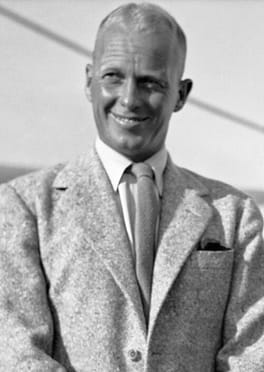
Photo: Los Angeles Times / CC BY 4.0 (source: Wikimedia Commons)
John Farrow was born on February 10, 1904 in Marrickville, New South Wales, Australia and was credited as a film director, screenwriter and naval officer. John Farrow died on January 27, 1963 at the age of 58. Awards on record include Commander of the Order of the British Empire, Knight Grand Cross in the Order of the Holy Sepulchre, Academy Award for Best Writing, Adapted Screenplay (1957) and 1 more. Notable works include Hondo, Alias Nick Beal and The Big Clock.
My Take
John Farrow fascinates me as a true journeyman of old Hollywood. Born in Marrickville, Australia in 1904, he became a director, writer, producer and even served as a naval officer, spending much of his career in the United States. He won the 1957 Academy Award for adapting Around the World in Eighty Days and earned a Best Director nomination for Wake Island. I'm drawn to his darker work though, taut noirs like The Big Clock and Night Has a Thousand Eyes, plus the western Hondo. A Walk of Fame star and a CBE round out a remarkably varied life cut short in 1963.
This take was written by generative AI, one per person, from publicly reported facts (editorial policy). It is a reading of the record, not reporting.
1. Profile
- Name (English)
- John Farrow
- Name (Japanese)
- ジョン・ファロー
- Reading
- じょん・ふぁろー
- Born
- February 10, 1904 – January 27, 1963
- Origin
- Marrickville, New South Wales, Australia
- Occupation
- film director / screenwriter / naval officer / actor / film producer
- Zodiac / Chinese zodiac
- Aquarius / Dragon
2. Background
Awards & achievements
- Commander of the Order of the British Empire
- Knight Grand Cross in the Order of the Holy Sepulchre
- 1957 Academy Award for Best Writing, Adapted Screenplay
- star on Hollywood Walk of Fame
3. Works & records
Filmography / notable works
| Category | Title |
|---|---|
| Notable work | Hondo |
| Notable work | Alias Nick Beal |
| Notable work | The Big Clock |
| Notable work | Night Has a Thousand Eyes |
4. Links
- Wikipedia (English)https://en.wikipedia.org/wiki/John%20Farrow
- Wikipedia (Japanese)https://ja.wikipedia.org/wiki/%E3%82%B8%E3%83%A7%E3%83%B3%E3%83%BB%E3%83%95%E3%82%A1%E3%83%AD%E3%83%BC
- Wikidatahttps://www.wikidata.org/wiki/Q547495
5. About this entry
Tags
- Last updated
Facts are limited to publicly available information up to 2024; non-public or unconfirmed items are omitted. English text is machine-assisted (facts translated by Sonnet, "My Take" written by Opus 4.8). The Japanese page is the source of record.
Frequently asked questions
When was John Farrow born?
Born February 10, 1904.
When did John Farrow die?
Died January 27, 1963, aged 58.
Where was John Farrow from?
John Farrow was from Marrickville, New South Wales, Australia.
What did John Farrow do?
John Farrow worked as film director, screenwriter, naval officer, actor, film producer.
What was John Farrow known for?
Notable works include Hondo, Alias Nick Beal, The Big Clock.
Film director — see all → · Screenwriter — see all → · More people from Australia →