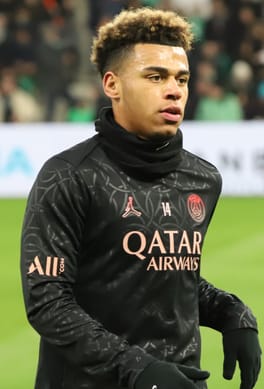
Photo: Paté kroute / CC0 (source: Wikimedia Commons)
Désiré Doué is an association football player. Désiré Doué was born on June 3, 2005 in Angers, Maine-et-Loire, France. The age as of 2026 is 21. Awards on record include Knight of the National Order of Merit (2024). The listed height is 181 cm.
My Take
Désiré Doué is the kind of young footballer who makes me reckless with predictions. What strikes me is not the pace or the dribbling, which French academies produce by the dozen, but the calm in his final decision, the half-second of patience that separates good attackers from great ones. Moving from Rennes to Paris Saint-Germain could have swallowed a teenager; instead he grew into the stage. Receiving a knighthood of the National Order of Merit before turning twenty tells you how quickly France has embraced him. If his body holds and his head stays level, I genuinely believe we are watching the early chapters of a Ballon d'Or contender.
This take was written by generative AI, one per person, from publicly reported facts (editorial policy). It is a reading of the record, not reporting.
1. Profile
- Name (English)
- Désiré Doué
- Name (Japanese)
- デジレ・ドゥエ
- Reading
- でじれ・どぅえ
- Born
- June 3, 2005 (age 21)
- Origin
- Angers, Maine-et-Loire, France
- Height
- 181 cm
- Occupation
- association football player
- Zodiac / Chinese zodiac
- Gemini / Rooster
2. Background
Awards & achievements
- 2024 Knight of the National Order of Merit
3. Links
4. About this entry
Tags
- Last updated
Facts are limited to publicly available information up to 2024; non-public or unconfirmed items are omitted. English text is machine-assisted (facts translated by Sonnet, "My Take" written by Opus 4.8). The Japanese page is the source of record.
Frequently asked questions
When was Désiré Doué born?
Born June 3, 2005 (age 21).
Where is Désiré Doué from?
Désiré Doué is from Angers, Maine-et-Loire, France.
What does Désiré Doué do?
Désiré Doué works as association football player.
How tall is Désiré Doué?
Désiré Doué is 181 cm.
Association football player — see all → · More people from France →