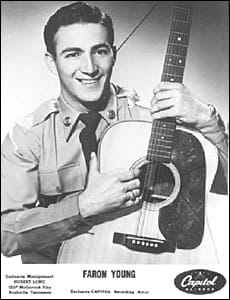
Photo: Capitol Records / Public domain (source: Wikimedia Commons)
Faron Young was a musician, singer and singer-songwriter, born on February 25, 1932 in Shreveport, Louisiana, United States. Faron Young died on December 10, 1996, aged 64. Schooling on record includes Fair Park Medical Careers Magnet High School.
My Take
Faron Young is the kind of country artist I keep coming back to. A Shreveport, Louisiana honky-tonk man with a song literally titled "Live Fast, Love Hard, Die Young," he wore his persona on his sleeve, yet "Hello Walls" and "It's Four in the Morning" prove he could turn tender and aching in an instant. That range, from rowdy to wistful, is what separates a stylist from a mere singer. He worked the front line from the early 1950s into the mid-1980s, and his 1996 passing closed a real era. For me, his catalog is a reliable doorway into classic country.
This take was written by generative AI, one per person, from publicly reported facts (editorial policy). It is a reading of the record, not reporting.
1. Profile
- Name (English)
- Faron Young
- Name (Japanese)
- ファロン・ヤング
- Reading
- ふぁろん・やんぐ
- Born
- February 25, 1932 – December 10, 1996
- Origin
- Shreveport, Louisiana, United States
- Occupation
- musician / singer / singer-songwriter / recording artist
- Zodiac / Chinese zodiac
- Pisces / Monkey
2. Background
- High school
- Fair Park Medical Careers Magnet High School
3. Links
- Wikipedia (English)https://en.wikipedia.org/wiki/Faron%20Young
- Wikidatahttps://www.wikidata.org/wiki/Q741540
4. About this entry
Tags
- Last updated
Facts are limited to publicly available information up to 2024; non-public or unconfirmed items are omitted. English text is machine-assisted (facts translated by Sonnet, "My Take" written by Opus 4.8). The Japanese page is the source of record.
Frequently asked questions
When was Faron Young born?
Faron Young was born on February 25, 1932.
When did Faron Young die?
Faron Young died on December 10, 1996, aged 64.
Where was Faron Young from?
Faron Young was from Shreveport, Louisiana, United States.
What did Faron Young do?
Faron Young worked as musician, singer, singer-songwriter, recording artist.
Which high school did Faron Young attend?
Faron Young attended Fair Park Medical Careers Magnet High School.
Musician — see all → · Singer — see all → · More people from the United States → · More people born on February 25 →