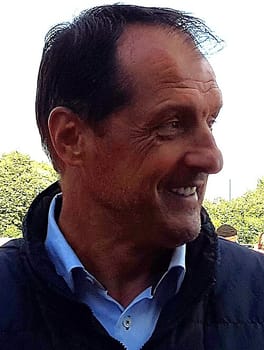
Photo: Supporterhéninois / CC0 (source: Wikimedia Commons)
Faruk Hadžibegić was born on October 7, 1957 in Sarajevo, Sarajevo Canton, Bosnia and Herzegovina. Faruk Hadžibegić is listed as an association football player and association football coach. That works out to 68 years old in 2026. The listed height is 183 cm.
My Take
Faruk Hadžibegić carries a weight that goes beyond football. A defender born in Sarajevo, he represented Yugoslavia at Euro 1984 and the 1990 World Cup, and with 61 caps he stands as the country's fifth-most-capped player. That alone marks him as a defensive cornerstone of his era, but the historical backdrop, a national team that would soon vanish with the country itself, gives his career a poignancy I can't ignore. He later moved into management, passing his experience to a new generation. To me he embodies how the best defenders lead with intelligence and resilience long after they stop playing.
This take was written by generative AI, one per person, from publicly reported facts (editorial policy). It is a reading of the record, not reporting.
1. Profile
- Name (English)
- Faruk Hadžibegić
- Name (Japanese)
- ファルク・ハジベギッチ
- Reading
- ふぁるく・はじべぎっち
- Born
- October 7, 1957 (age 68)
- Origin
- Sarajevo, Sarajevo Canton, Bosnia and Herzegovina
- Height
- 183 cm
- Occupation
- association football player / association football coach
- Zodiac / Chinese zodiac
- Libra / Rooster
2. Links
3. About this entry
Tags
- Last updated
Facts are limited to publicly available information up to 2024; non-public or unconfirmed items are omitted. English text is machine-assisted (facts translated by Sonnet, "My Take" written by Opus 4.8). The Japanese page is the source of record.
Frequently asked questions
When was Faruk Hadžibegić born?
Born October 7, 1957 (age 68).
Where is Faruk Hadžibegić from?
Faruk Hadžibegić is from Sarajevo, Sarajevo Canton, Bosnia and Herzegovina.
What does Faruk Hadžibegić do?
Faruk Hadžibegić works as association football player, association football coach.
How tall is Faruk Hadžibegić?
Faruk Hadžibegić is 183 cm.
Association football player — see all → · Association football coach — see all → · More people from Bosnia and Herzegovina →