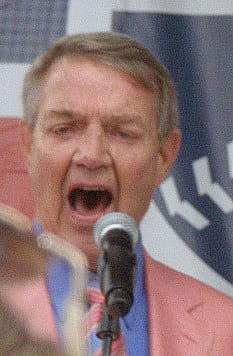
Photo: Flickr user phillymads63 / CC BY 2.0 (source: Wikimedia Commons)
Born on March 26, 1936, Harry Kalas was from Naperville, Illinois, United States. Harry Kalas was a sports commentator. Death is recorded on April 13, 2009, at the age of 73. Education on record includes Naperville Central High School and University of Iowa.
My Take
What strikes me about Harry Kalas is the rarity of his loyalty. Calling Phillies games from 1971 until his death in 2009, he essentially became the audio identity of a franchise for nearly four decades, and that Frick Award was well earned. I find something deeply moving in a broadcaster who never retired but worked right up to the end, as if the booth and the man were inseparable. To me he represents a vanishing breed of homegrown announcers whose voices carried generations of fans through both heartbreak and glory. Cities remember voices like his long after the scores fade.
This take was written by generative AI, one per person, from publicly reported facts (editorial policy). It is a reading of the record, not reporting.
1. Profile
- Name (English)
- Harry Kalas
- Name (Japanese)
- ハリー・カラス
- Reading
- はりー・からす
- Born
- March 26, 1936 – April 13, 2009
- Origin
- Naperville, Illinois, United States
- Occupation
- sports commentator
- Zodiac / Chinese zodiac
- Aries / Rat
2. Background
- High school
- Naperville Central High School
- University
- University of Iowa
3. Links
- Wikipedia (English)https://en.wikipedia.org/wiki/Harry%20Kalas
- Wikipedia (Japanese)https://ja.wikipedia.org/wiki/%E3%83%8F%E3%83%AA%E3%83%BC%E3%83%BB%E3%82%AB%E3%83%A9%E3%82%B9
- Wikidatahttps://www.wikidata.org/wiki/Q4354593
4. About this entry
Tags
- Last updated
Facts are limited to publicly available information up to 2024; non-public or unconfirmed items are omitted. English text is machine-assisted (facts translated by Sonnet, "My Take" written by Opus 4.8). The Japanese page is the source of record.
Frequently asked questions
When was Harry Kalas born?
Born March 26, 1936.
When did Harry Kalas die?
Died April 13, 2009, aged 73.
Where was Harry Kalas from?
Harry Kalas was from Naperville, Illinois, United States.
What did Harry Kalas do?
Harry Kalas worked as sports commentator.
Sports commentator — see all → · More people from the United States →