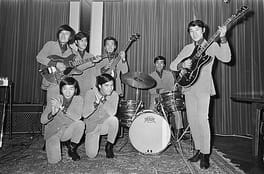
Photo: Jack de Nijs for Anefo / No restrictions (source: Wikimedia Commons)
My Take
I've always had a soft spot for Monsieur Kamayatsu, and honestly he's one of those guys who makes "cool" look effortless. As the guitarist and one of the voices of The Spiders, he sat right at the center of Japan's Group Sounds explosion in the '60s, when rock and pop were genuinely shaking up the country's youth. But what gets me isn't the fame so much as the vibe: he never seemed to push, never seemed to sweat, just drifted into a room and made everything around him a little more stylish. Singer, songwriter, guitarist, actor, he could do it all without ever looking like he was trying. Even into his later years that laid-back voice and easy grin pulled younger musicians toward him. He passed in 2017, but that breezy, do-it-his-own-way charm still feels timeless to me.
This take was written by generative AI, one per person, from publicly reported facts (editorial policy). It is a reading of the record, not reporting.
Overview
Hiroshi Kamayatsu (January 12, 1939 – March 1, 2017) was a Japanese singer, composer, guitarist, and actor born in Tokyo. He rose to prominence as a key member of the Group Sounds band The Spiders, one of the most influential rock groups in Japan during the 1960s. Known for his relaxed playing style and distinctive vocal presence, he remained active across music and acting throughout his career. He passed away on March 1, 2017.
1. Profile
- Name (English)
- Hiroshi Kamayatsu
- Name (Japanese)
- かまやつひろし
- Reading
- かまやつひろし
- Born
- January 12, 1939 – March 1, 2017
- Origin
- Tokyo, Japan
- Occupation
- Singer / Composer / Actor / Guitarist
- Zodiac / Chinese zodiac
- Capricorn / Rabbit
2. Works & records
Works summary
- Appearances
- 181 (1960–2017)
- By year (titles with a known year)
- 1960: 8, 1961: 15, 1963: 2, 1964: 1, 1967: 3, 1968: 4, 1969: 4, 1970: 7, 1971: 7, 1972: 8, 1973: 4, 1974: 3, 1975: 2, 1976: 2, 1977: 3, 1978: 5, 1979: 1, 1980: 2, 1981: 5, 1982: 3, 1983: 3, 1984: 5, 1985: 1, 1986: 1, 1987: 3, 1988: 2, 1989: 1, 1990: 3, 1991: 2, 1992: 1, 1993: 2, 1994: 1, 1995: 1, 1996: 1, 1998: 1, 2000: 2, 2001: 2, 2004: 2, 2006: 1, 2007: 3, 2008: 1, 2010: 1, 2012: 1, 2017: 1, year unknown: 50
- Debut work
- 殺し屋のテーマ c/w 皆殺しの歌
Filmography / notable works
| Category | Title | Role | Year |
|---|---|---|---|
| Song provided | DEADHEAT | 2017 | |
| TV drama | ガールズトーク〜十人のシスターたち〜 | 2012 | |
| Concert | ap bank fes '10 | 2010 | |
| TV drama | 無理な恋愛 | 2008 | |
| Film | The Yakiniku Movie: Bulgogi | 2007 | |
| Concert | 大山ミュージックリゾート in 花回廊 | 2007 | |
| Other | LEGENDS ムッシュかまやつ Keep On Running | 2007 | |
| Concert | 吉田拓郎 & かぐや姫 Concert in つま恋 2006 | 2006 | |
| Film | Ghost Shout | 2004 | |
| TV drama | Xmasなんて大嫌い | 2004 | |
| TV drama | 金田一少年の事件簿 | 2001 | |
| Concert | Dream Power ジョン・レノン スーパー・ライヴ | 2001 | |
| Song provided | 耒タルベキ素敵 | 2000 | |
| Film | Getting Wild with Our Monkey | 2000 | |
| Film | 探偵誕生 | as ミスター | 1998 |
| Other | 太陽は罪な奴 | 1996 | |
| Song provided | SMILE A GO GO! | 1995 | |
| やつらの足音のバラード/ALLORA… | 1994 | ||
| Song provided | BLUE DIAMOND | 1993 | |
| Dubbing | ベビーシッター・アドベンチャー | 1993 | |
| Song provided | 雨の動物園 | 1992 | |
| 雨の小径で恋をして/Kの週末 | 1991 | ||
| Song provided | 恋の歌 | 1991 | |
| すてきな僕ら/BLUEでできた僕たちの楽園 | 1990 | ||
| Song provided | Ho Ho Ho… | 1990 | |
| Film | Boku to, bokura no natsu | 1990 | |
| キスの下手な男/Bitter For My Taste | 1989 | ||
| ノー・ノー・ボーイ/ノー・ノー・ボーイ | 1988 | ||
| Song provided | Sail Away Forever | 1988 | |
| Song provided | 大人はわかってくれない | 1987 | |
| Song provided | 瞬間 | 1987 | |
| Song provided | 放課後デート | 1987 | |
| ワンナイト・スタンド・ブラザース/欠陥BOY × 欠陥GIRL | 1986 | ||
| ゴロワーズを吸ったことがあるかい/我が良き友よ | 1985 | ||
| エリマキトカゲの真実/襟巻きと影 | 1984 | ||
| Song provided | Boy's Life | 1984 | |
| Song provided | I'm A 北海道 Man | 1984 | |
| Song provided | 星の歌を聴きながら | 1984 | |
| TV drama | ビートたけしの学問ノススメ | 1984 | |
| Song provided | DO YOU REMEMBER? 直線回帰 | 1983 | |
| Song provided | Mild Weekend | 1983 | |
| TV drama | さよなら三角 | 1983 | |
| アイコ16歳 | 1982 | ||
| Song provided | ボートハウスに連れてって | 1982 | |
| TV drama | なんとなくソクラテス | 1982 | |
| 旅の歌/また逢う日まで | 1981 | ||
| あの時君は若かった/ノー・ノー・ボーイ | 1981 | ||
| Song provided | GSチック | 1981 | |
| Song provided | GS伝説 | 1981 | |
| Song provided | S/T/R/I/P/P/E/R | 1981 |
3. Links
4. About this entry
Tags
- Last updated
Only publicly available facts are listed; non-public or unconfirmed items are omitted. Base data was compiled from Wikidata from June 2026 onward; ages are recalculated daily and deaths are checked against Wikidata on an ongoing basis. Works and profile fields sourced from Wikipedia reflect content as of 2026-08-26. English text is machine-assisted (facts translated by Sonnet, "My Take" written by Opus 4.8). The Japanese page is the source of record.
Frequently asked questions
When was Hiroshi Kamayatsu born?
Hiroshi Kamayatsu was born on January 12, 1939.
When did Hiroshi Kamayatsu die?
Hiroshi Kamayatsu died on March 1, 2017, aged 78.
Where was Hiroshi Kamayatsu from?
Hiroshi Kamayatsu was from Tokyo, Japan.
What did Hiroshi Kamayatsu do?
Hiroshi Kamayatsu worked as Singer, Composer, Actor, Guitarist.
What was Hiroshi Kamayatsu known for?
Hiroshi Kamayatsu's notable works include DEADHEAT, ap bank fes '10, SMILE A GO GO!.
Singer — see all → · Composer — see all → · More people from Japan → · More people born on January 12 →