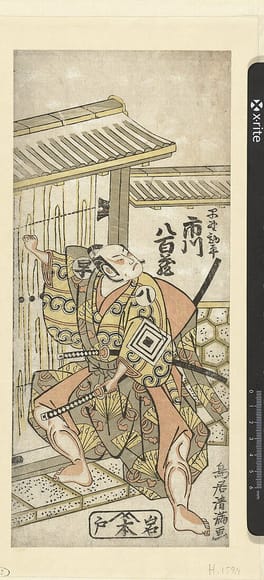
Photo: Rijksmuseum / CC0 (source: Wikimedia Commons)
My Take
Ichikawa Yaozō I is one of those figures who exists almost entirely as a name — born in 1730, dead by 1759 at what was probably around 29, leaving almost no paper trail beyond the fact that he was the founding holder of a kabuki stage name that would outlive him by centuries. And honestly, that name alone does a lot of heavy lifting: "Yaozō" carries a kind of weight you can't fake. He walked the hanamichi in Edo's theaters during the mid-Tokugawa period, when kabuki was arguably at its most electrically alive as popular entertainment, and whatever he did on that stage was enough to get a lineage named after him. I find it quietly moving that someone could burn so briefly — less than three decades of life — and still plant a flag sturdy enough for successors to claim. We'll never know the details, and maybe that's fine. Some people are just a name, a date, and a very good reason to imagine the rest.
This take was written by generative AI, one per person, from publicly reported facts (editorial policy). It is a reading of the record, not reporting.
Overview
Ichikawa Yaozō I was an Edo-period kabuki actor born in 1730, and the founding holder of the Ichikawa Yaozō name lineage. He died on December 8, 1759, at approximately 29 years of age. His birthplace within Japan is unknown, and detailed biographical records from his brief career have not been preserved. He is the first in a succession of actors to carry the Ichikawa Yaozō stage name.
1. Profile
- Name (English)
- Ichikawa Yaozō I
- Name (Japanese)
- 初代 市川八百蔵
- Reading
- いちかわ やおぞう
- Born
- 1730 – December 8, 1759
- Origin
- Japan
- Occupation
- Kabuki actor
- Zodiac / Chinese zodiac
- Dog
2. Links
3. About this entry
Tags
- Last updated
Facts are limited to publicly available information up to 2024; non-public or unconfirmed items are omitted. English text is machine-assisted (facts translated by Sonnet, "My Take" written by Opus 4.8). The Japanese page is the source of record.
Frequently asked questions
Where was Ichikawa Yaozō I from?
Ichikawa Yaozō I was from Japan.
What did Ichikawa Yaozō I do?
Ichikawa Yaozō I worked as Kabuki actor.