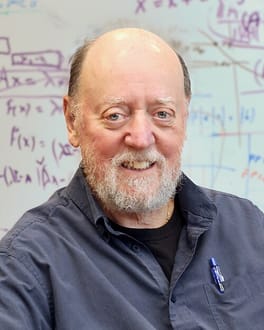
Photo: ICLTSG / CC BY-SA 4.0 (source: Wikimedia Commons)
Jack Dongarra was born on July 18, 1950 in Chicago, Illinois, United States and is credited as a mathematician, computer scientist and engineer. That puts Jack Dongarra at 76 years old in 2026. Schooling on record includes University of New Mexico. Listed accolades include Ken Kennedy Award (2013), Sidney Fernbach Award (2003), ACM Fellow (2001) and 5 more. Credited works include EISPACK and LAPACK.
My Take
Jack Dongarra is the kind of figure I most enjoy spotlighting, the quiet engine behind things we take for granted. A Chicago-born computer scientist, he authored numerical libraries like LAPACK and EISPACK that silently power supercomputers, weather models, and scientific research across the planet. His 2021 Turing Award, computing's equivalent of a Nobel, finally put a public face on decades of foundational work. I'm drawn to people who advance humanity from the basement rather than the stage, and Dongarra strengthened the very floor that modern science stands on. To me, that invisible influence is far more impressive than any spotlight.
This take was written by generative AI, one per person, from publicly reported facts (editorial policy). It is a reading of the record, not reporting.
1. Profile
- Name (English)
- Jack Dongarra
- Name (Japanese)
- ジャック・ドンガラ
- Reading
- じゃっく・どんがら
- Born
- July 18, 1950 (age 76)
- Origin
- Chicago, Illinois, United States
- Occupation
- mathematician / computer scientist / engineer / university teacher
- Zodiac / Chinese zodiac
- Cancer / Tiger
2. Background
- University
- University of New Mexico
Awards & achievements
- 2013 Ken Kennedy Award
- 2003 Sidney Fernbach Award
- 2001 ACM Fellow
- IEEE Fellow
- 2009 Fellow of the Society for Industrial and Applied Mathematics
- Fellow of the American Association for the Advancement of Science
- 2019 Foreign Member of the Royal Society
- 2021 Turing Award
3. Works & records
Filmography / notable works
| Category | Title |
|---|---|
| Notable work | EISPACK |
| Notable work | LAPACK |
4. Links
- Official sitehttps://netlib.org/utk/people/JackDongarra/
- Wikipedia (English)https://en.wikipedia.org/wiki/Jack%20Dongarra
- Wikipedia (Japanese)https://ja.wikipedia.org/wiki/%E3%82%B8%E3%83%A3%E3%83%83%E3%82%AF%E3%83%BB%E3%83%89%E3%83%B3%E3%82%AC%E3%83%A9
- Wikidatahttps://www.wikidata.org/wiki/Q92670
5. About this entry
Tags
- Last updated
Facts are limited to publicly available information up to 2024; non-public or unconfirmed items are omitted. English text is machine-assisted (facts translated by Sonnet, "My Take" written by Opus 4.8). The Japanese page is the source of record.
Frequently asked questions
When was Jack Dongarra born?
Born July 18, 1950 (age 76).
Where is Jack Dongarra from?
Jack Dongarra is from Chicago, Illinois, United States.
What does Jack Dongarra do?
Jack Dongarra works as mathematician, computer scientist, engineer, university teacher.
What is Jack Dongarra known for?
Notable works include EISPACK, LAPACK.
Mathematician — see all → · Computer scientist — see all → · More people from the United States →