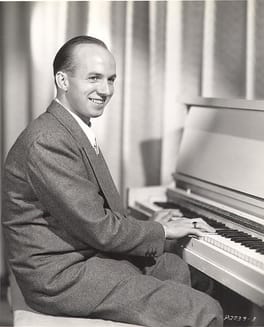
Photo: Unknown author / Public domain (source: Wikimedia Commons)
Jimmy Van Heusen was born on January 26, 1913 in Syracuse, New York, United States. Public records list Jimmy Van Heusen as a songwriter, pianist and film score composer. Death is recorded on February 6, 1990, at the age of 77. Schooling on record includes Nottingham High School and Syracuse University. Listed accolades include Academy Award for Best Original Song (1945, 1958, 1960, 1964).
My Take
What strikes me about Jimmy Van Heusen is how he hid a knack for timeless melody behind a borrowed name. Born Edward Chester Babcock in Syracuse, he ended up with four Academy Awards for Best Original Song, and I find that consistency more impressive than any single hit. Plenty of composers get one lucky song; landing the Oscar across 1945, 1958, 1960 and 1964 tells me he understood what audiences and singers actually wanted to hear. The fact that so many of his pieces drifted into the jazz-standard repertoire is the real proof for me. That is when a songwriter stops being a name and becomes part of the language.
This take was written by generative AI, one per person, from publicly reported facts (editorial policy). It is a reading of the record, not reporting.
1. Profile
- Name (English)
- Jimmy Van Heusen
- Name (Japanese)
- ジミー・ヴァン・ヒューゼン
- Reading
- じみー・ゔぁん・ひゅーぜん
- Born
- January 26, 1913 – February 6, 1990
- Origin
- Syracuse, New York, United States
- Occupation
- composer / songwriter / pianist / film score composer / musician
- Zodiac / Chinese zodiac
- Aquarius / Ox
2. Background
- High school
- Nottingham High School
- University
- Syracuse University
Awards & achievements
- 1945 Academy Award for Best Original Song
- 1958 Academy Award for Best Original Song
- 1960 Academy Award for Best Original Song
- 1964 Academy Award for Best Original Song
3. Links
- Official sitehttps://www.jimmyvanheusen.com
- Wikipedia (English)https://en.wikipedia.org/wiki/Jimmy%20Van%20Heusen
- Wikipedia (Japanese)https://ja.wikipedia.org/wiki/%E3%82%B8%E3%83%9F%E3%83%BC%E3%83%BB%E3%83%B4%E3%82%A1%E3%83%B3%E3%83%BB%E3%83%92%E3%83%A5%E3%83%BC%E3%82%BC%E3%83%B3
- Wikidatahttps://www.wikidata.org/wiki/Q33124
4. About this entry
Tags
- Last updated
Facts are limited to publicly available information up to 2024; non-public or unconfirmed items are omitted. English text is machine-assisted (facts translated by Sonnet, "My Take" written by Opus 4.8). The Japanese page is the source of record.
Frequently asked questions
When was Jimmy Van Heusen born?
Born January 26, 1913.
When did Jimmy Van Heusen die?
Died February 6, 1990, aged 77.
Where was Jimmy Van Heusen from?
Jimmy Van Heusen was from Syracuse, New York, United States.
What did Jimmy Van Heusen do?
Jimmy Van Heusen worked as composer, songwriter, pianist, film score composer, musician.
Composer — see all → · Songwriter — see all → · More people from the United States →