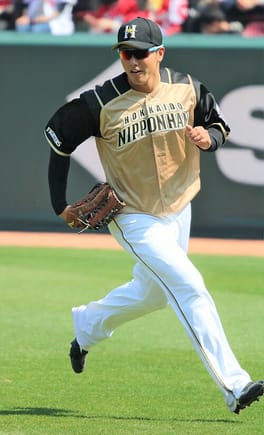
Photo: えすぱにぃ / CC BY-SA 4.0 (source: Wikimedia Commons)
My Take
Standing at 188cm, Keisuke Moriyama is the kind of player who looks the part before he even swings a bat or winds up a pitch — that height alone commands attention on any diamond. He honed his game at Senshu University, so he went the college baseball route, building fundamentals the slow and patient way rather than jumping straight to the pros out of high school. A Kurobe, Toyama native who was a left-handed ace at Seiryo, he became a slugging outfielder at Senshu, won the Eastern League home run title as a Nippon-Ham rookie, and retired after the 2019 season without breaking through with the first team. That is a very old-school baseball story, and I respect it.
This take was written by generative AI, one per person, from publicly reported facts (editorial policy). It is a reading of the record, not reporting.
Overview
Keisuke Moriyama is a Japanese former professional baseball player born on May 2, 1994, in Kurobe, Toyama Prefecture. He stands 188 cm tall, was the ace at Seiryo High School, converted to the outfield and captained Senshu University, and played for the Hokkaido Nippon-Ham Fighters from 2017 to 2019, leading the Eastern League in home runs as a rookie.
1. Profile
- Name (English)
- Keisuke Moriyama
- Name (Japanese)
- 森山恵佑
- Reading
- もりやま けいすけ
- Born
- May 2, 1994 (age 32)
- Origin
- Kurobe, Toyama Prefecture, Japan
- Height
- 188 cm
- Occupation
- Baseball Player
- Zodiac / Chinese zodiac
- Taurus / Dog
2. Background
- University
- Senshu University
3. Links
4. About this entry
Tags
- Last updated
Only publicly available facts are listed; non-public or unconfirmed items are omitted. Base data was compiled from Wikidata from June 2026 onward; ages are recalculated daily and deaths are checked against Wikidata on an ongoing basis. English text is machine-assisted (facts translated by Sonnet, "My Take" written by Opus 4.8). The Japanese page is the source of record.
Frequently asked questions
When was Keisuke Moriyama born?
Keisuke Moriyama was born on May 2, 1994 and is 32 years old.
Where is Keisuke Moriyama from?
Keisuke Moriyama is from Kurobe, Toyama Prefecture, Japan.
What does Keisuke Moriyama do?
Keisuke Moriyama works as Baseball Player.
How tall is Keisuke Moriyama?
Keisuke Moriyama is 188 cm tall.
Where did Keisuke Moriyama study?
Keisuke Moriyama attended Senshu University.
Baseball Player — see all → · More people from Japan → · More people born on May 2 →