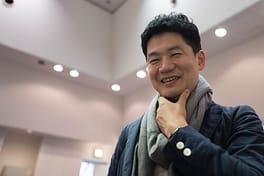
Photo: Joi Ito / CC BY 2.0 (source: Wikimedia Commons)
My Take
Koichiro Eto is one of those researchers who genuinely seems to enjoy blowing up the boundary between nerd culture and academia. His work at Japan's National Institute of Advanced Industrial Science and Technology sits squarely at the intersection of human-computer interaction, media art, and wikis — which already sounds like a fun place to spend a career — but the thing that makes him interesting to me is the Nico Nico Gakkai Beta project. Taking one of Japan's most chaotic, meme-saturated video platforms and turning it into a venue for real academic presentations? That's a legitimately clever idea about where knowledge actually lives in the internet age. Keio and then a doctorate at University of Tokyo, pattern languages as a lens on creativity — this is a guy with range, and I appreciate that he seems to operate at the fringes of what "serious research" is supposed to look like.
This take was written by generative AI, one per person, from publicly reported facts (editorial policy). It is a reading of the record, not reporting.
Overview
Kōichirō Eto is a Japanese computer scientist born in 1971. He studied at Keio University and is active in the field of computer science. He maintains a personal website at eto.com and an account on X (formerly Twitter).
1. Profile
- Name (English)
- Kōichirō Eto
- Name (Japanese)
- 江渡浩一郎
- Reading
- えと こういちろう
- Born
- 1971
- Origin
- Japan
- Occupation
- Computer Scientist
- Zodiac / Chinese zodiac
- Boar
2. Background
- University
- Keio University
3. Links
- Official sitehttp://eto.com/
- Xhttps://x.com/KoichiroEto
- Wikipedia (Japanese)https://ja.wikipedia.org/wiki/%E6%B1%9F%E6%B8%A1%E6%B5%A9%E4%B8%80%E9%83%8E
- Wikidatahttps://www.wikidata.org/wiki/Q18338618
4. About this entry
Tags
- Last updated
Only publicly available facts are listed; non-public or unconfirmed items are omitted. Base data was compiled from Wikidata from June 2026 onward; ages are recalculated daily and deaths are checked against Wikidata on an ongoing basis. English text is machine-assisted (facts translated by Sonnet, "My Take" written by Opus 4.8). The Japanese page is the source of record.
Frequently asked questions
Where is Kōichirō Eto from?
Kōichirō Eto is from Japan.
What does Kōichirō Eto do?
Kōichirō Eto works as Computer Scientist.
Where did Kōichirō Eto study?
Kōichirō Eto attended Keio University.