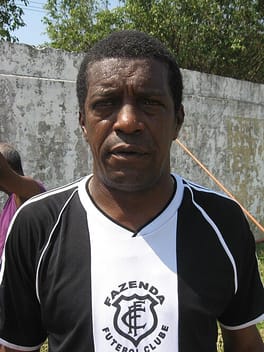
Photo: Original uploader was Junius at pt.wikipedia / Public domain (source: Wikimedia Commons)
Marco Antônio, born on February 6, 1951 in Santos, São Paulo, Brazil, is an association football player. As of 2026, Marco Antônio is 75 years old. The listed height is 180 cm.
My Take
Marco Antônio Feliciano stands in a special tier for me. Born in Santos in 1951, he was the left-back on Brazil's mythic 1970 World Cup-winning side, sharing a pitch with the greatest team ever assembled. Five Campeonato Carioca titles with Fluminense and back-to-back Silver Ball awards in 1975 and 1976 confirm he was no mere passenger. Full-backs rarely get the headlines, yet that golden Brazil shone partly because reliable craftsmen like him did the unseen work. I hold deep respect for players who anchor legends, and Marco Antônio absolutely earned that place.
This take was written by generative AI, one per person, from publicly reported facts (editorial policy). It is a reading of the record, not reporting.
1. Profile
- Name (English)
- Marco Antônio
- Name (Japanese)
- マルコ・アントニオ・フェリシアーノ
- Reading
- まるこ・あんとにお・ふぇりしあーの
- Born
- February 6, 1951 (age 75)
- Origin
- Santos, São Paulo, Brazil
- Height
- 180 cm
- Occupation
- association football player
- Zodiac / Chinese zodiac
- Aquarius / Rabbit
2. Links
- Wikipedia (English)https://en.wikipedia.org/wiki/Marco%20Ant%C3%B4nio%20(footballer%2C%20born%201951)
- Wikipedia (Japanese)https://ja.wikipedia.org/wiki/%E3%83%9E%E3%83%AB%E3%82%B3%E3%83%BB%E3%82%A2%E3%83%B3%E3%83%88%E3%83%8B%E3%82%AA%E3%83%BB%E3%83%95%E3%82%A7%E3%83%AA%E3%82%B7%E3%82%A2%E3%83%BC%E3%83%8E
- Wikidatahttps://www.wikidata.org/wiki/Q2294414
3. About this entry
Tags
- Last updated
Facts are limited to publicly available information up to 2024; non-public or unconfirmed items are omitted. English text is machine-assisted (facts translated by Sonnet, "My Take" written by Opus 4.8). The Japanese page is the source of record.
Frequently asked questions
When was Marco Antônio born?
Born February 6, 1951 (age 75).
Where is Marco Antônio from?
Marco Antônio is from Santos, São Paulo, Brazil.
What does Marco Antônio do?
Marco Antônio works as association football player.
How tall is Marco Antônio?
Marco Antônio is 180 cm.
Association football player — see all → · More people from Brazil →