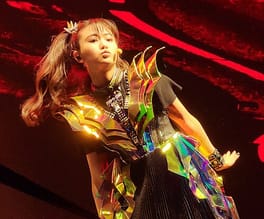
Photo: Crisco 1492 / CC BY-SA 4.0 (source: Wikimedia Commons)
My Take
So this is Moa Kikuchi, aka Moametal of BABYMETAL, and honestly she's one of those people who quietly rewires how you think about what a "pop idol" can be. I first clocked her as basically a kid, all giggles and peace signs, and somehow she grew up headbanging on festival stages where she didn't share a language with half the crowd, yet had them throwing devil horns anyway. That's the trick that gets me: under the bubbly Nagoya-girl charm there's this steel-spined precision, full-throttle metal choreography executed with idol-perfect timing. Founding member, lifer at this point, born in 1999 and performing since she could barely tie her shoes. I love that a tiny Japanese girl basically exported a whole genre-bending culture and made the West bow. Quietly fearless. Genuinely cool.
This take was written by generative AI, one per person, from publicly reported facts (editorial policy). It is a reading of the record, not reporting.
Overview
Moa Kikuchi (born July 4, 1999, in Nagoya, Aichi Prefecture, Japan) is a Japanese singer, talent, and model best known as Moametal, one of the core members of the internationally acclaimed metal idol group BABYMETAL. She began performing as a child and grew into one of the group's central figures, appearing on major stages worldwide. She is represented by Amuse and was formerly a member of the idol group Sakura Gakuin.
1. Profile
- Name (English)
- Moa Kikuchi
- Name (Japanese)
- 菊地最愛
- Reading
- きくち もあ
- Born
- July 4, 1999 (age 27)
- Origin
- Nagoya, Aichi Prefecture, Japan
- Occupation
- Singer / Child Actor / Talent / Model
- Zodiac / Chinese zodiac
- Cancer / Rabbit
- Agency
- Amuse
- Active years
- 2007 -
2. Works & records
Works summary
- Appearances
- 2
Filmography / notable works
| Category | Title |
|---|---|
| CM | マクドナルド ハッピーセット |
| Book | ちゃお |
3. Links
4. About this entry
Tags
- Last updated
Only publicly available facts are listed; non-public or unconfirmed items are omitted. Base data was compiled from Wikidata from June 2026 onward; ages are recalculated daily and deaths are checked against Wikidata on an ongoing basis. Works and profile fields sourced from Wikipedia reflect content as of 2026-08-26. English text is machine-assisted (facts translated by Sonnet, "My Take" written by Opus 4.8). The Japanese page is the source of record.
Frequently asked questions
When was Moa Kikuchi born?
Moa Kikuchi was born on July 4, 1999 and is 27 years old.
Where is Moa Kikuchi from?
Moa Kikuchi is from Nagoya, Aichi Prefecture, Japan.
What does Moa Kikuchi do?
Moa Kikuchi works as Singer, Child Actor, Talent, Model.
What agency is Moa Kikuchi with?
Moa Kikuchi is with Amuse.
How long has Moa Kikuchi been active?
Moa Kikuchi has been active since 2007.
Singer — see all → · Child Actor — see all → · More people from Japan → · More people born on July 4 →