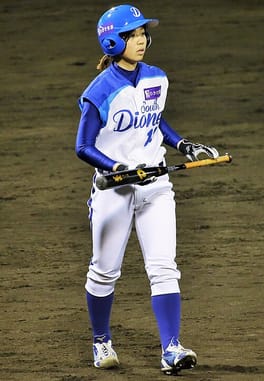
Photo: Sakuraikubuki / CC BY 3.0 (source: Wikimedia Commons)
My Take
Honestly, a girl from Katori City, Chiba picking up a baseball glove and making it her thing is the kind of origin story I love. Born in July 1995, she's smack in that generation of women who grew up watching baseball as a boys' sport and decided to play it anyway, which takes a certain quiet stubbornness that I genuinely respect. Women's baseball still gets the "wait, that's a real league?" treatment from a lot of people, and that makes sticking with it mean something more. She won a national title at Saitama Sakae High School, then played professionally from 2014 to 2019, collecting a 2017 Golden Glove at first base, a 2018 home-run award and her 100th hit — the kind of work done without a spotlight demanding it.
This take was written by generative AI, one per person, from publicly reported facts (editorial policy). It is a reading of the record, not reporting.
Overview
Nami Okumura is a Japanese baseball player born on July 19, 1995, in Katori, Chiba Prefecture, Japan. She won the national high school women's championship with Saitama Sakae High School, played in Japan's women's professional baseball league from 2014 to 2019, and won the Golden Glove at first base in 2017. She has an account on X.
1. Profile
- Name (English)
- Nami Okumura
- Name (Japanese)
- 奥村奈未
- Reading
- おくむら なみ
- Born
- July 19, 1995 (age 31)
- Origin
- Katori, Chiba Prefecture, Japan
- Occupation
- Baseball player
- Zodiac / Chinese zodiac
- Cancer / Boar
2. Links
3. About this entry
Tags
- Last updated
Only publicly available facts are listed; non-public or unconfirmed items are omitted. Base data was compiled from Wikidata from June 2026 onward; ages are recalculated daily and deaths are checked against Wikidata on an ongoing basis. English text is machine-assisted (facts translated by Sonnet, "My Take" written by Opus 4.8). The Japanese page is the source of record.
Frequently asked questions
When was Nami Okumura born?
Nami Okumura was born on July 19, 1995 and is 31 years old.
Where is Nami Okumura from?
Nami Okumura is from Katori, Chiba Prefecture, Japan.
What does Nami Okumura do?
Nami Okumura works as Baseball player.
Baseball player — see all → · More people from Japan → · More people born on July 19 →