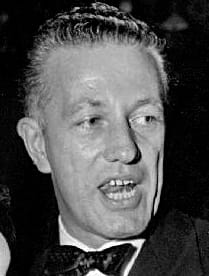
Photo: Nat Dallinger / Public domain (source: Wikimedia Commons)
Nicholas Ray was born on August 7, 1911 in La Crosse, Wisconsin, United States. Public records list Nicholas Ray as a film director, screenwriter and actor. Death is recorded on June 16, 1979, at the age of 67. Education on record includes Lincoln Park High School and University of Chicago.
My Take
Nicholas Ray is one of those directors who Hollywood half-broke and the French New Wave had to rescue from obscurity — Godard and Truffaut practically canonized him while American studios were still treating him like a difficult employee. Born in La Crosse, Wisconsin in 1911, he came up through theater under Frank Lloyd Wright's Taliesin fellowship and left-wing political circles, and that restless, anti-establishment energy bleeds into every frame he shot. Rebel Without a Cause alone would be enough to cement a legacy — the way he captured James Dean's raw anguish against the cool artifice of 1950s suburbia is still stunning — but In a Lonely Place and Johnny Guitar show just how deep his range ran. He burned bright and burned out, dying in 1979, but the films endure as genuinely personal works in an era when that was nearly impossible.
This take was written by generative AI, one per person, from publicly reported facts (editorial policy). It is a reading of the record, not reporting.
1. Profile
- Name (English)
- Nicholas Ray
- Name (Japanese)
- ニコラス・レイ
- Reading
- にこらす・れい
- Born
- August 7, 1911 – June 16, 1979
- Origin
- La Crosse, Wisconsin, United States
- Occupation
- film director / screenwriter / actor / director
- Zodiac / Chinese zodiac
- Leo / Boar
2. Background
- High school
- Lincoln Park High School
- University
- University of Chicago
3. Links
- Wikipedia (English)https://en.wikipedia.org/wiki/Nicholas%20Ray
- Wikipedia (Japanese)https://ja.wikipedia.org/wiki/%E3%83%8B%E3%82%B3%E3%83%A9%E3%82%B9%E3%83%BB%E3%83%AC%E3%82%A4
- Wikidatahttps://www.wikidata.org/wiki/Q240677
4. About this entry
Tags
- Last updated
Only publicly available facts are listed; non-public or unconfirmed items are omitted. Base data was compiled from Wikidata from June 2026 onward; ages are recalculated daily and deaths are checked against Wikidata on an ongoing basis. English text is machine-assisted (facts translated by Sonnet, "My Take" written by Opus 4.8). The Japanese page is the source of record.
Frequently asked questions
When was Nicholas Ray born?
Nicholas Ray was born on August 7, 1911.
When did Nicholas Ray die?
Nicholas Ray died on June 16, 1979, aged 67.
Where was Nicholas Ray from?
Nicholas Ray was from La Crosse, Wisconsin, United States.
What did Nicholas Ray do?
Nicholas Ray worked as film director, screenwriter, actor, director.
Where did Nicholas Ray study?
Nicholas Ray attended University of Chicago.
Film director — see all → · Screenwriter — see all → · More people from the United States → · More people born on August 7 →