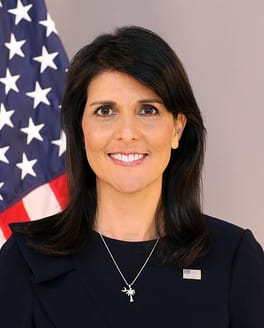
Photo: United States Department of State / Public domain (source: Wikimedia Commons)
Nikki Haley is a politician, diplomat and businessperson, born on January 20, 1972 in Bamberg, South Carolina, United States. As of 2026, Nikki Haley is 54 years old. Schooling on record includes Clemson University. Recorded honors include honorary doctorate of the University of South Carolina (2015), Order of the Palmetto (2010) and Irving Kristol Award (2019).
My Take
Nikki Haley is one of those political figures who genuinely broke barriers in ways that don't get enough credit — the daughter of Sikh immigrants from Punjab who grew up in small-town Bamberg, South Carolina, and worked her way up to become the state's first female governor and, later, the first Indian American to serve in a presidential cabinet as UN Ambassador. I find her fascinating precisely because she defies easy categorization: she governed South Carolina as a pragmatic conservative, drew genuine international respect at the UN, and then ran a surprisingly competitive 2024 Republican primary campaign long after most observers expected her to fold. Whether you agree with her politics or not, the arc from Clemson accounting graduate to the floor of the UN Security Council is legitimately impressive, and her ability to operate across very different political arenas shows a real sharpness that I think gets underestimated.
This take was written by generative AI, one per person, from publicly reported facts (editorial policy). It is a reading of the record, not reporting.
1. Profile
- Name (English)
- Nikki Haley
- Name (Japanese)
- ニッキー・ヘイリー
- Reading
- にっきー・へいりー
- Born
- January 20, 1972 (age 54)
- Origin
- Bamberg, South Carolina, United States
- Occupation
- politician / diplomat / businessperson / writer / ambassador
- Zodiac / Chinese zodiac
- Aquarius / Rat
2. Background
- University
- Clemson University
Awards & achievements
- 2015 honorary doctorate of the University of South Carolina
- 2010 Order of the Palmetto
- 2019 Irving Kristol Award
3. Links
- Official sitehttps://nikkihaley.com/
- Instagramhttps://www.instagram.com/nikkihaley/
- Xhttps://x.com/nikkihaley
- Wikipedia (English)https://en.wikipedia.org/wiki/Nikki%20Haley
- Wikipedia (Japanese)https://ja.wikipedia.org/wiki/%E3%83%8B%E3%83%83%E3%82%AD%E3%83%BC%E3%83%BB%E3%83%98%E3%82%A4%E3%83%AA%E3%83%BC
- Wikidatahttps://www.wikidata.org/wiki/Q11668
4. About this entry
Tags
- Last updated
Only publicly available facts are listed; non-public or unconfirmed items are omitted. Base data was compiled from Wikidata from June 2026 onward; ages are recalculated daily and deaths are checked against Wikidata on an ongoing basis. English text is machine-assisted (facts translated by Sonnet, "My Take" written by Opus 4.8). The Japanese page is the source of record.
Frequently asked questions
When was Nikki Haley born?
Nikki Haley was born on January 20, 1972 and is 54 years old.
Where is Nikki Haley from?
Nikki Haley is from Bamberg, South Carolina, United States.
What does Nikki Haley do?
Nikki Haley works as politician, diplomat, businessperson, writer, ambassador.
Where did Nikki Haley study?
Nikki Haley attended Clemson University.
Politician — see all → · Diplomat — see all → · More people from the United States → · More people born on January 20 →