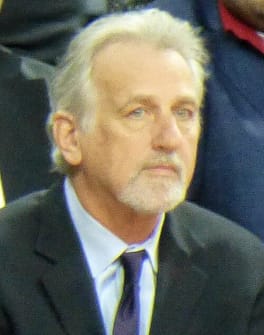
Photo: GabboT / CC BY-SA 2.0 (source: Wikimedia Commons)
Paul Westphal was born in Torrance, California, United States on November 30, 1950. Paul Westphal was listed as a basketball player, basketball coach and sports commentator. Death is recorded on January 2, 2021, at the age of 70. Schooling on record includes Aviation High School and University of Southern California. The listed height was 193 cm.
My Take
Paul Westphal's arc is one of basketball's great full circles: he won a 1974 title with Boston, then returned to the Finals in 1976 against those same Celtics in a Phoenix uniform. What draws me to him is that he refused to be only a player, moving on to coach and to commentate, wringing every angle out of the game he clearly loved. A guard with that much craft tends to see the floor like a chessboard, and I suspect his analysis carried real authority. His death in 2021 closed a life lived entirely inside the sport, and I'd have given a lot to hear him break down a game in person.
This take was written by generative AI, one per person, from publicly reported facts (editorial policy). It is a reading of the record, not reporting.
1. Profile
- Name (English)
- Paul Westphal
- Name (Japanese)
- ポール・ウェストファル
- Reading
- ぽーる・うぇすとふぁる
- Born
- November 30, 1950 – January 2, 2021
- Origin
- Torrance, California, United States
- Height
- 193 cm
- Occupation
- basketball player / basketball coach / sports commentator / head coach
- Zodiac / Chinese zodiac
- Sagittarius / Tiger
2. Background
- High school
- Aviation High School
- University
- University of Southern California
3. Links
4. About this entry
Tags
- Last updated
Facts are limited to publicly available information up to 2024; non-public or unconfirmed items are omitted. English text is machine-assisted (facts translated by Sonnet, "My Take" written by Opus 4.8). The Japanese page is the source of record.
Frequently asked questions
When was Paul Westphal born?
Born November 30, 1950.
When did Paul Westphal die?
Died January 2, 2021, aged 70.
Where was Paul Westphal from?
Paul Westphal was from Torrance, California, United States.
What did Paul Westphal do?
Paul Westphal worked as basketball player, basketball coach, sports commentator, head coach.
How tall was Paul Westphal?
Paul Westphal was 193 cm.
Basketball player — see all → · Basketball coach — see all → · More people from the United States →