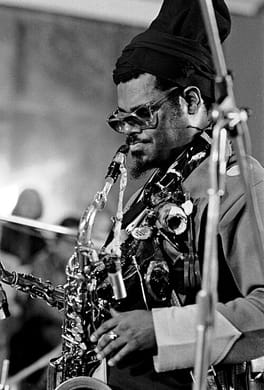
Photo: Heinrich Klaffs / CC BY-SA 2.0 (source: Wikimedia Commons)
Born on August 7, 1935, Rahsaan Roland Kirk was from Columbus, Ohio, United States. Rahsaan Roland Kirk was listed as a composer, clarinetist and saxophonist. Death is recorded on December 5, 1977, at the age of 42.
My Take
Rahsaan Roland Kirk is one of those musicians who genuinely makes you rethink what's possible on a stage — the man was legally blind and still managed to play two or three saxophones simultaneously, circular-breathe his way through extended passages without pausing for air, and somehow make it all feel less like a circus trick and more like pure musical logic. Born in Columbus, Ohio in 1935, he developed a ferociously individual voice rooted in the blues and hard bop before expanding outward into free jazz and beyond. He called his multi-horn approach "multi-horn" not as a gimmick but as a way to voice chords and harmonies a single horn couldn't touch. Even a 1975 stroke that paralyzed one side of his body couldn't stop him — he adapted his technique and kept performing right up until his death in 1977 at just 42. That's not tragedy, that's pure dedication to the music.
This take was written by generative AI, one per person, from publicly reported facts (editorial policy). It is a reading of the record, not reporting.
1. Profile
- Name (English)
- Rahsaan Roland Kirk
- Name (Japanese)
- ローランド・カーク
- Reading
- ろーらんど・かーく
- Born
- August 7, 1935 – December 5, 1977
- Origin
- Columbus, Ohio, United States
- Occupation
- composer / clarinetist / saxophonist / oboist / jazz musician
- Zodiac / Chinese zodiac
- Leo / Boar
2. Links
- Official sitehttp://www.alfanet.hu/kirk
- Wikipedia (English)https://en.wikipedia.org/wiki/Rahsaan%20Roland%20Kirk
- Wikipedia (Japanese)https://ja.wikipedia.org/wiki/%E3%83%AD%E3%83%BC%E3%83%A9%E3%83%B3%E3%83%89%E3%83%BB%E3%82%AB%E3%83%BC%E3%82%AF
- Wikidatahttps://www.wikidata.org/wiki/Q553921
3. About this entry
Tags
- Last updated
Only publicly available facts are listed; non-public or unconfirmed items are omitted. Base data was compiled from Wikidata from June 2026 onward; ages are recalculated daily and deaths are checked against Wikidata on an ongoing basis. English text is machine-assisted (facts translated by Sonnet, "My Take" written by Opus 4.8). The Japanese page is the source of record.
Frequently asked questions
When was Rahsaan Roland Kirk born?
Rahsaan Roland Kirk was born on August 7, 1935.
When did Rahsaan Roland Kirk die?
Rahsaan Roland Kirk died on December 5, 1977, aged 42.
Where was Rahsaan Roland Kirk from?
Rahsaan Roland Kirk was from Columbus, Ohio, United States.
What did Rahsaan Roland Kirk do?
Rahsaan Roland Kirk worked as composer, clarinetist, saxophonist, oboist, jazz musician.
Composer — see all → · Clarinetist — see all → · More people from the United States → · More people born on August 7 →