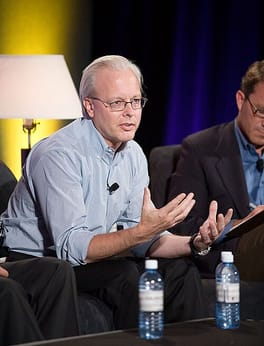
Photo: Unknown author / CC BY 2.0 (source: Wikimedia Commons)
Ray Ozzie is credited as a programmer, computer scientist and engineer. Ray Ozzie was born in Chicago, Illinois, United States on November 20, 1955. The age as of 2026 is 70. Education on record includes Maine South High School and University of Illinois Urbana-Champaign. Listed accolades include W. Wallace McDowell Award (2000).
My Take
Ray Ozzie is one of those figures I deeply admire from the sidelines. The Chicago-born engineer behind Lotus Notes, he later succeeded Bill Gates as Microsoft's Chief Software Architect, which is about as heavy a torch as anyone in software can be handed. What impresses me most is timing: he was sketching out collaborative groupware decades before online co-working felt natural to anyone. So much of how we work together today traces back to seeds he planted. He never sought the spotlight the way founders do, and that's exactly why I think of him as a quiet giant who rewired how the world gets things done.
This take was written by generative AI, one per person, from publicly reported facts (editorial policy). It is a reading of the record, not reporting.
1. Profile
- Name (English)
- Ray Ozzie
- Name (Japanese)
- レイ・オジー
- Reading
- れい・おじー
- Born
- November 20, 1955 (age 70)
- Origin
- Chicago, Illinois, United States
- Occupation
- programmer / computer scientist / engineer / businessperson
- Zodiac / Chinese zodiac
- Scorpio / Goat
2. Background
- High school
- Maine South High School
- University
- University of Illinois Urbana-Champaign
Awards & achievements
- 2000 W. Wallace McDowell Award
3. Links
- Official sitehttp://ozzie.net/about
- Xhttps://x.com/rozzie
- Wikipedia (English)https://en.wikipedia.org/wiki/Ray%20Ozzie
- Wikipedia (Japanese)https://ja.wikipedia.org/wiki/%E3%83%AC%E3%82%A4%E3%83%BB%E3%82%AA%E3%82%B8%E3%83%BC
- Wikidatahttps://www.wikidata.org/wiki/Q92637
4. About this entry
Tags
- Last updated
Facts are limited to publicly available information up to 2024; non-public or unconfirmed items are omitted. English text is machine-assisted (facts translated by Sonnet, "My Take" written by Opus 4.8). The Japanese page is the source of record.
Frequently asked questions
When was Ray Ozzie born?
Born November 20, 1955 (age 70).
Where is Ray Ozzie from?
Ray Ozzie is from Chicago, Illinois, United States.
What does Ray Ozzie do?
Ray Ozzie works as programmer, computer scientist, engineer, businessperson.
Programmer — see all → · Computer scientist — see all → · More people from the United States →