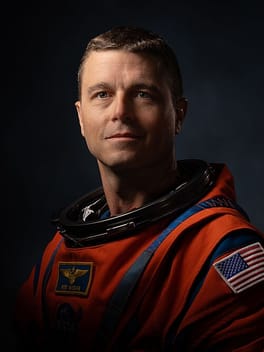
Photo: Josh Valcarcel / Public domain (source: Wikimedia Commons)
Reid Wiseman is credited as a naval officer, astronaut and systems engineer. Reid Wiseman was born in Baltimore, Maryland, United States on November 11, 1975. The age as of 2026 is 50. Education on record includes Dulaney High School and Johns Hopkins University. Listed accolades include Air Medal.
My Take
Reid Wiseman is the kind of astronaut who makes the whole enterprise feel human again — a Navy test pilot from Baltimore who flew combat missions, earned an Air Medal, and then somehow topped all of that with a long stay aboard the International Space Station on Expedition 40/41 in 2014. What made him stand out wasn't just the resume; it was the sense that he genuinely couldn't believe his luck, an infectious wonder that pulls people into caring about spaceflight. Then NASA made him chief of the Astronaut Office, which is less a desk job and more the person who decides which humans leave the planet — no small thing. Selected to command Artemis II, he's been the face of humanity's return to the Moon, and honestly, I can't think of a better one: decorated combat pilot, curious engineer, and the commander who took a crew around the Moon.
This take was written by generative AI, one per person, from publicly reported facts (editorial policy). It is a reading of the record, not reporting.
1. Profile
- Name (English)
- Reid Wiseman
- Name (Japanese)
- リード・ワイズマン
- Reading
- りーど・わいずまん
- Born
- November 11, 1975 (age 50)
- Origin
- Baltimore, Maryland, United States
- Occupation
- naval officer / astronaut / systems engineer / fighter pilot / test pilot
- Zodiac / Chinese zodiac
- Scorpio / Rabbit
2. Background
- High school
- Dulaney High School
- University
- Johns Hopkins University
Awards & achievements
- Air Medal
3. Links
- Instagramhttps://www.instagram.com/astro_reid/
- Xhttps://x.com/Astro_Reid
- Wikipedia (English)https://en.wikipedia.org/wiki/Reid%20Wiseman
- Wikipedia (Japanese)https://ja.wikipedia.org/wiki/%E3%83%AA%E3%83%BC%E3%83%89%E3%83%BB%E3%83%AF%E3%82%A4%E3%82%BA%E3%83%9E%E3%83%B3
- Wikidatahttps://www.wikidata.org/wiki/Q3116390
4. About this entry
Tags
- Last updated
Only publicly available facts are listed; non-public or unconfirmed items are omitted. Base data was compiled from Wikidata from June 2026 onward; ages are recalculated daily and deaths are checked against Wikidata on an ongoing basis. English text is machine-assisted (facts translated by Sonnet, "My Take" written by Opus 4.8). The Japanese page is the source of record.
Frequently asked questions
When was Reid Wiseman born?
Reid Wiseman was born on November 11, 1975 and is 50 years old.
Where is Reid Wiseman from?
Reid Wiseman is from Baltimore, Maryland, United States.
What does Reid Wiseman do?
Reid Wiseman works as naval officer, astronaut, systems engineer, fighter pilot, test pilot.
Where did Reid Wiseman study?
Reid Wiseman attended Johns Hopkins University.
Naval officer — see all → · Astronaut — see all → · More people from the United States → · More people born on November 11 →