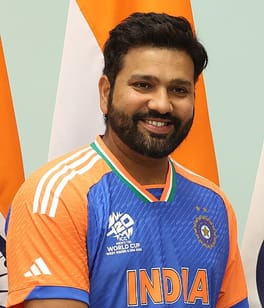
Photo: Prime Minister's Office / GODL-India (source: Wikimedia Commons)
Rohit Sharma was born on April 30, 1987 in Nagpur, Nagpur district, India. Rohit Sharma is credited as a cricketer. That works out to 39 years old in 2026. Education on record includes Our Lady of Vailankanni High School and Swami Vivekanand International School and Junior College. Awards on record include Arjuna Award (2015), Major Dhyan Chand Khel Ratna Award in Sports and Games (2020) and Wisden Cricketer of the Year (2022).
My Take
Rohit Sharma interests me as a study in patient greatness. He reinvented himself as an opener and became one of the most destructive top-order batters the modern game has seen, then took on the heaviest job in sport: captaining India in every format, with a billion opinions weighing on every dismissal. What I respect most is the calm. The Arjuna Award and the Khel Ratna only formalize what fans already knew, that he turned elegance into relentless output. From Nagpur to the summit of world cricket, his career argues that timing and temperament matter just as much as raw gift, and I find that genuinely instructive.
This take was written by generative AI, one per person, from publicly reported facts (editorial policy). It is a reading of the record, not reporting.
1. Profile
- Name (English)
- Rohit Sharma
- Name (Japanese)
- ロヒット・シャルマ
- Reading
- ろひっと・しゃるま
- Born
- April 30, 1987 (age 39)
- Origin
- Nagpur, Nagpur district, India
- Height
- 174 cm
- Occupation
- cricketer
- Zodiac / Chinese zodiac
- Taurus / Rabbit
2. Background
- High school
- Our Lady of Vailankanni High School
- University
- Swami Vivekanand International School and Junior College
Awards & achievements
- 2015 Arjuna Award
- 2020 Major Dhyan Chand Khel Ratna Award in Sports and Games
- 2022 Wisden Cricketer of the Year
3. Links
- Instagramhttps://www.instagram.com/rohitsharma45/
- Xhttps://x.com/ImRo45
- Wikipedia (English)https://en.wikipedia.org/wiki/Rohit%20Sharma
- Wikipedia (Japanese)https://ja.wikipedia.org/wiki/%E3%83%AD%E3%83%92%E3%83%83%E3%83%88%E3%83%BB%E3%82%B7%E3%83%A3%E3%83%AB%E3%83%9E
- Wikidatahttps://www.wikidata.org/wiki/Q3520045
4. About this entry
Tags
- Last updated
Facts are limited to publicly available information up to 2024; non-public or unconfirmed items are omitted. English text is machine-assisted (facts translated by Sonnet, "My Take" written by Opus 4.8). The Japanese page is the source of record.
Frequently asked questions
When was Rohit Sharma born?
Born April 30, 1987 (age 39).
Where is Rohit Sharma from?
Rohit Sharma is from Nagpur, Nagpur district, India.
What does Rohit Sharma do?
Rohit Sharma works as cricketer.
How tall is Rohit Sharma?
Rohit Sharma is 174 cm.