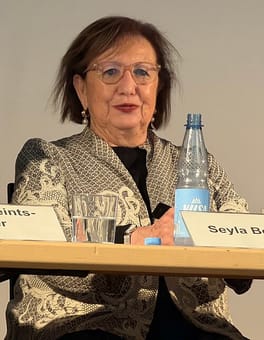
Photo: Ot / CC BY-SA 4.0 (source: Wikimedia Commons)
Seyla Benhabib was born on September 9, 1950 in Istanbul, Istanbul Province, Turkey and is credited as a university teacher, philosopher and essayist. Seyla Benhabib is 76 years old as of 2026. Schooling on record includes Yale University. Awards on record include Guggenheim Fellowship, Ernst Bloch Award (2009), Dr. Leopold Lucas Prize (2012) and 5 more.
My Take
Seyla Benhabib strikes me as one of those thinkers whose biography and ideas mirror each other beautifully. Born in Istanbul and becoming a leading American philosopher, she spent a career wrestling with belonging, citizenship, and who counts as a member of a political community, questions she clearly lived as well as theorized. The sheer weight of her honors, from a Guggenheim to the Leopold Lucas Prize and multiple honorary doctorates, signals a mind the scholarly world takes seriously. I find her work quietly essential: rigorous, humane, and unusually attuned to a world where people increasingly live across borders.
This take was written by generative AI, one per person, from publicly reported facts (editorial policy). It is a reading of the record, not reporting.
1. Profile
- Name (English)
- Seyla Benhabib
- Name (Japanese)
- セイラ・ベンハビブ
- Reading
- せいら・べんはびぶ
- Born
- September 9, 1950 (age 76)
- Origin
- Istanbul, Istanbul Province, Turkey
- Occupation
- university teacher / philosopher / essayist / biographer / political scientist
- Zodiac / Chinese zodiac
- Virgo / Tiger
2. Background
- University
- Yale University
Awards & achievements
- Guggenheim Fellowship
- 2009 Ernst Bloch Award
- 2012 Dr. Leopold Lucas Prize
- 2014 Meister Eckhart Prize
- 2010 honorary doctor of the University of Valencia
- Fellow of the American Academy of Arts and Sciences
- 2018 Honorary doctorate from the University of Geneva
- 2005 Ralph J. Bunche Award
3. Links
4. About this entry
Tags
- Last updated
Facts are limited to publicly available information up to 2024; non-public or unconfirmed items are omitted. English text is machine-assisted (facts translated by Sonnet, "My Take" written by Opus 4.8). The Japanese page is the source of record.
Frequently asked questions
When was Seyla Benhabib born?
Born September 9, 1950 (age 76).
Where is Seyla Benhabib from?
Seyla Benhabib is from Istanbul, Istanbul Province, Turkey.
What does Seyla Benhabib do?
Seyla Benhabib works as university teacher, philosopher, essayist, biographer, political scientist.
University teacher — see all → · Philosopher — see all → · More people from Turkey →