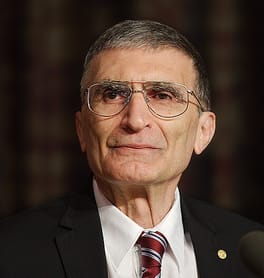
Photo: Holger Motzkau / CC BY-SA 3.0 (source: Wikimedia Commons)
Born on September 8, 1946, Aziz Sancar is from Savur district, Mardin Province, Turkey. Aziz Sancar is listed as a biochemist, molecular biologist and university teacher. That works out to 80 years old in 2026. Education on record includes University of Texas at Dallas. Recorded honors include Nobel Prize in Chemistry (2015), Fellow of the American Academy of Arts and Sciences, Presidential Young Investigator Award (1984) and 5 more.
My Take
Aziz Sancar's story floors me. Born in the small village of Savur in Turkey's Mardin Province, he crossed the world to study in Texas and went on to map how cells repair their own damaged DNA, work that earned him the 2015 Nobel Prize in Chemistry. The patience required to chase such an intricate mechanism, year after year at the bench, is staggering. As the first Turkish scientist to win a Nobel in the sciences, he carries real symbolic weight too. What I find most moving is the distance traveled, from rural Anatolia to the frontier of molecular biology, closed entirely by stubborn, careful experiment. I hold his work in deep respect.
This take was written by generative AI, one per person, from publicly reported facts (editorial policy). It is a reading of the record, not reporting.
1. Profile
- Name (English)
- Aziz Sancar
- Name (Japanese)
- アジズ・サンジャル
- Reading
- あじず・さんじゃる
- Born
- September 8, 1946 (age 80)
- Origin
- Savur district, Mardin Province, Turkey
- Occupation
- biochemist / molecular biologist / university teacher / geneticist / scientist
- Zodiac / Chinese zodiac
- Virgo / Dog
2. Background
- University
- University of Texas at Dallas
Awards & achievements
- 2015 Nobel Prize in Chemistry
- Fellow of the American Academy of Arts and Sciences
- 1984 Presidential Young Investigator Award
- 2016 Bert and Natalie Vallee Award in Biomedical Science
- honorary diploma of President of Azerbaijan Republic
- 2016 North Carolina Award for Public Service
- International Alisher Navoi Prize
- Member of the National Academy of Sciences of the United States
3. Links
- Official sitehttps://sancar.org/
- Xhttps://x.com/AzizGwenSancar
- Wikipedia (English)https://en.wikipedia.org/wiki/Aziz%20Sancar
- Wikipedia (Japanese)https://ja.wikipedia.org/wiki/%E3%82%A2%E3%82%B8%E3%82%BA%E3%83%BB%E3%82%B5%E3%83%B3%E3%82%B8%E3%83%A3%E3%83%AB
- Wikidatahttps://www.wikidata.org/wiki/Q15118973
4. About this entry
Tags
- Last updated
Facts are limited to publicly available information up to 2024; non-public or unconfirmed items are omitted. English text is machine-assisted (facts translated by Sonnet, "My Take" written by Opus 4.8). The Japanese page is the source of record.
Frequently asked questions
When was Aziz Sancar born?
Born September 8, 1946 (age 80).
Where is Aziz Sancar from?
Aziz Sancar is from Savur district, Mardin Province, Turkey.
What does Aziz Sancar do?
Aziz Sancar works as biochemist, molecular biologist, university teacher, geneticist, scientist.