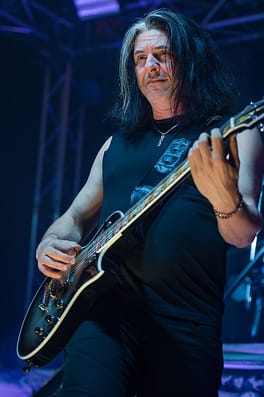
Photo: Stefan Brending (2eight) / CC BY-SA 3.0 de (source: Wikimedia Commons)
My Take
Alex Skolnick is the rare shredder who genuinely earned his musical-chameleon credentials. His leads on Testament's 'The Legacy' and 'The New Order' were melodic and tasteful in a way that set him apart from the pack of late-1980s thrash players. Then he did the unthinkable for a metal guitarist, walked away, got a serious jazz education, and came back able to reharmonize Scorpions and Black Sabbath tunes for an acoustic jazz trio. That fearlessness about genre, plus his obvious intelligence as a player and writer, makes him one of the most respected and versatile guitarists of his generation.
This take was written by generative AI, one per person, from publicly reported facts (editorial policy). It is a reading of the record, not reporting.
Overview
Alex Skolnick (born September 29, 1968) is an American guitarist from Berkeley, California. He first rose to prominence as the lead guitarist of the Bay Area thrash metal band Testament, contributing to acclaimed albums in the late 1980s and early 1990s. After studying jazz, he formed the Alex Skolnick Trio, reinventing rock and metal classics as jazz arrangements, and is also a member of the supergroup Metal Allegiance, bridging the worlds of metal and jazz.
1. Profile
- Name (English)
- Alex Skolnick
- Name (Japanese)
- アレックス・スコルニック
- Reading
- あれっくす・すこるにっく
- Born
- September 29, 1968 (age 57)
- Origin
- Berkeley, California, United States
- Occupation
- Guitarist / Jazz musician / Jazz guitarist / Composer / Musician
- Zodiac / Chinese zodiac
- Libra / Monkey
2. Links
- Official sitehttps://alexskolnick.com/
- Instagramhttps://www.instagram.com/alexskolnick/
- Xhttps://x.com/AlexSkolnick
- Wikipedia (English)https://en.wikipedia.org/wiki/Alex%20Skolnick
- Wikipedia (Japanese)https://ja.wikipedia.org/wiki/%E3%82%A2%E3%83%AC%E3%83%83%E3%82%AF%E3%82%B9%E3%83%BB%E3%82%B9%E3%82%B3%E3%83%AB%E3%83%8B%E3%83%83%E3%82%AF
- Wikidatahttps://www.wikidata.org/wiki/Q443818
3. About this entry
Tags
- Last updated
Facts are limited to publicly available information up to 2024; non-public or unconfirmed items are omitted. English text is machine-assisted (facts translated by Sonnet, "My Take" written by Opus 4.8). The Japanese page is the source of record.
Frequently asked questions
When was Alex Skolnick born?
Born September 29, 1968 (age 57).
Where is Alex Skolnick from?
Alex Skolnick is from Berkeley, California, United States.
What does Alex Skolnick do?
Alex Skolnick works as Guitarist, Jazz musician, Jazz guitarist, Composer, Musician.
Guitarist — see all → · Jazz musician — see all → · More people from the United States →