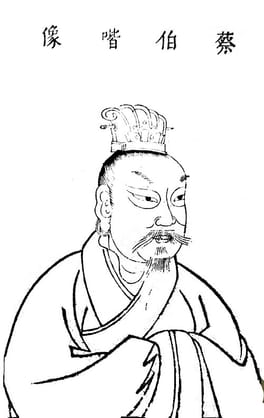
Photo: Wang Qi / Public domain (source: Wikimedia Commons)
Public records list Cai Yong as an astronomer, historian and writer. Cai Yong died on 192.
My Take
Cai Yong is one of those figures from ancient history who makes you stop and think — how did one person fit so much into a single life? Active during the Eastern Han dynasty in the second century, he was a calligrapher, musician, mathematician, astronomer, historian, and politician all at once, at a time when those disciplines were barely separated. His calligraphy was so respected that the stone classics he helped inscribe outside the Imperial Academy drew crowds of scholars copying his work. He also invented the guqin style known as Jiao Wei, according to tradition, and his musicological writings survived long enough to influence later generations. What really gets me is that his daughter Cai Yan — also known as Cai Wenji — became one of the most celebrated poets in Chinese history, which tells you something about the household he ran. He died tragically in 192 CE, imprisoned after Dong Zhuo was killed, for allegedly grieving over him, mourned by students who admired him deeply. A genuine Renaissance man, two centuries before Europe invented the concept.
This take was written by generative AI, one per person, from publicly reported facts (editorial policy). It is a reading of the record, not reporting.
1. Profile
- Name (English)
- Cai Yong
- Name (Japanese)
- 蔡邕
- Reading
- さい よう
- Born
- 133 – 192
- Origin
- Qi County, People's Republic of China
- Occupation
- astronomer / historian / writer / politician / musician
- Zodiac / Chinese zodiac
- Rooster
2. Links
- Wikipedia (English)https://en.wikipedia.org/wiki/Cai%20Yong
- Wikipedia (Japanese)https://ja.wikipedia.org/wiki/%E8%94%A1%E9%82%95
- Wikidatahttps://www.wikidata.org/wiki/Q707702
3. About this entry
Tags
- Last updated
Only publicly available facts are listed; non-public or unconfirmed items are omitted. Base data was compiled from Wikidata from June 2026 onward; ages are recalculated daily and deaths are checked against Wikidata on an ongoing basis. English text is machine-assisted (facts translated by Sonnet, "My Take" written by Opus 4.8). The Japanese page is the source of record.
Frequently asked questions
Where was Cai Yong from?
Cai Yong was from Qi County, People's Republic of China.
What did Cai Yong do?
Cai Yong worked as astronomer, historian, writer, politician, musician.
Astronomer — see all → · Historian — see all → · More people from the People's Republic of China →