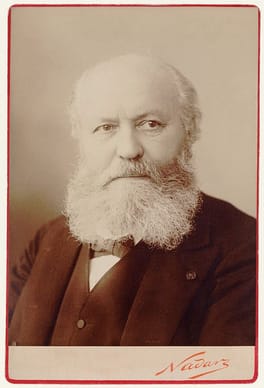
Photo: Nadar / Adam Cuerden / Public domain (source: Wikimedia Commons)
Charles Gounod was credited as a classical composer, musicologist and music educator. Charles Gounod was born on June 17, 1818 in Paris, France. Death is recorded on October 18, 1893, at the age of 75. Listed accolades include Prix de Rome (1839), Royal Philharmonic Society Gold Medal (1871), Commander of the Legion of Honour (1877) and 1 more. Credited works include Faust, Roméo et Juliete and Funeral March of a Marionette.
My Take
Charles Gounod is one of those composers whose music you know far better than his name — if you've ever watched Alfred Hitchcock's TV show, you've heard the Funeral March of a Marionette and probably hummed along without realizing who wrote it. But his real monument is Faust, which he finished in 1859 and which went on to become one of the most performed operas of the 19th century — a staggering achievement for any composer. Born in Paris in 1818, he won the prestigious Prix de Rome at just twenty-one, studied in Italy, and came back shaped by both sacred music and the grand theatrical tradition of French opera. His Roméo et Juliette proved he wasn't a one-hit wonder, and his Ave Maria — built over a Bach prelude — became a wedding and funeral staple worldwide. France honored him with the Grand Officer of the Legion of Honour, and honestly, for a man who could make tragedy sound so lush and inevitable, it feels well earned.
This take was written by generative AI, one per person, from publicly reported facts (editorial policy). It is a reading of the record, not reporting.
1. Profile
- Name (English)
- Charles Gounod
- Name (Japanese)
- シャルル・グノー
- Reading
- しゃるる・ぐのー
- Born
- June 17, 1818 – October 18, 1893
- Origin
- Paris, France
- Occupation
- classical composer / musicologist / music educator / organist / composer
- Zodiac / Chinese zodiac
- Gemini / Tiger
2. Background
Awards & achievements
- 1839 Prix de Rome
- 1871 Royal Philharmonic Society Gold Medal
- 1877 Commander of the Legion of Honour
- 1880 Grand Officer of the Legion of Honour
3. Works & records
Filmography / notable works
| Category | Title |
|---|---|
| Notable work | Faust |
| Notable work | Roméo et Juliete |
| Notable work | Funeral March of a Marionette |
4. Links
- Wikipedia (English)https://en.wikipedia.org/wiki/Charles%20Gounod
- Wikipedia (Japanese)https://ja.wikipedia.org/wiki/%E3%82%B7%E3%83%A3%E3%83%AB%E3%83%AB%E3%83%BB%E3%82%B0%E3%83%8E%E3%83%BC
- Wikidatahttps://www.wikidata.org/wiki/Q180278
5. About this entry
Tags
- Last updated
Facts are limited to publicly available information up to 2024; non-public or unconfirmed items are omitted. English text is machine-assisted (facts translated by Sonnet, "My Take" written by Opus 4.8). The Japanese page is the source of record.
Frequently asked questions
When was Charles Gounod born?
Born June 17, 1818.
When did Charles Gounod die?
Died October 18, 1893, aged 75.
Where was Charles Gounod from?
Charles Gounod was from Paris, France.
What did Charles Gounod do?
Charles Gounod worked as classical composer, musicologist, music educator, organist, composer.
What was Charles Gounod known for?
Notable works include Faust, Roméo et Juliete, Funeral March of a Marionette.