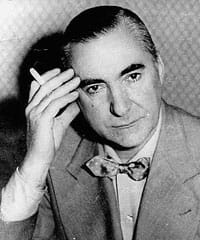
Photo: Unknown author / Public domain (source: Wikimedia Commons)
Born on June 9, 1898 in Prato, Province of Prato, Italy, Curzio Malaparte was a film director, screenwriter and journalist. Curzio Malaparte died on July 19, 1957 at the age of 59. Education on record includes Sapienza University of Rome. Recorded honors include War Cross for Military Valour.
My Take
Curzio Malaparte fascinates me because he lived several incompatible lives at once: novelist, filmmaker, war correspondent, diplomat. That restlessness bleeds into his prose, where beauty and atrocity are forever pressed against each other. Reading Kaputt and The Skin, I am struck by how someone who actually witnessed war, and was decorated for it, could render its horror with such unsettling, almost painterly precision. He was a man buffeted by his century's ideologies, yet he never stopped writing his way through the wreckage. I admire that defiance. He remains one of those Italian figures whose contradictions make him impossible to file away neatly.
This take was written by generative AI, one per person, from publicly reported facts (editorial policy). It is a reading of the record, not reporting.
1. Profile
- Name (English)
- Curzio Malaparte
- Name (Japanese)
- クルツィオ・マラパルテ
- Reading
- くるつぃお・まらぱるて
- Born
- June 9, 1898 – July 19, 1957
- Origin
- Prato, Province of Prato, Italy
- Occupation
- film director / screenwriter / journalist / diplomat / writer
- Zodiac / Chinese zodiac
- Gemini / Dog
2. Background
- University
- Sapienza University of Rome
Awards & achievements
- War Cross for Military Valour
3. Links
4. About this entry
Tags
- Last updated
Facts are limited to publicly available information up to 2024; non-public or unconfirmed items are omitted. English text is machine-assisted (facts translated by Sonnet, "My Take" written by Opus 4.8). The Japanese page is the source of record.
Frequently asked questions
When was Curzio Malaparte born?
Curzio Malaparte was born on June 9, 1898.
When did Curzio Malaparte die?
Curzio Malaparte died on July 19, 1957, aged 59.
Where was Curzio Malaparte from?
Curzio Malaparte was from Prato, Province of Prato, Italy.
What did Curzio Malaparte do?
Curzio Malaparte worked as film director, screenwriter, journalist, diplomat, writer.
Where did Curzio Malaparte study?
Curzio Malaparte attended Sapienza University of Rome.
Film director — see all → · Screenwriter — see all → · More people from Italy → · More people born on June 9 →