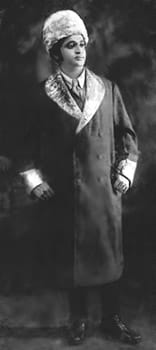
Photo: Unknown author / Public domain (source: Wikimedia Commons)
Deenanath Mangeshkar was listed as an actor and composer. Deenanath Mangeshkar was born on December 29, 1900 in Mangeshi, North Goa district, India. Death is recorded on April 24, 1942, at the age of 41.
My Take
Deenanath Mangeshkar moves me for what flowed downstream from him. Born in 1900 in the Goan village of Mangeshi, he was a master of Marathi theatre and Hindustani classical singing, but his deepest legacy is human: he fathered Lata Mangeshkar, Asha Bhosle, Meena Khadikar, Usha Mangeshkar, and Hridaynath. Knowing that the voices which reshaped Indian music were rooted in his own songs gives me chills. He died at just 41 in 1942, yet his blood and his sound passed cleanly to the next generation. We can rarely hear him directly, but he lives on in his children's voices. A truly great source.
This take was written by generative AI, one per person, from publicly reported facts (editorial policy). It is a reading of the record, not reporting.
1. Profile
- Name (English)
- Deenanath Mangeshkar
- Name (Japanese)
- ディーナーナート・マンゲシュカル
- Reading
- でぃーなーなーと・まんげしゅかる
- Born
- December 29, 1900 – April 24, 1942
- Origin
- Mangeshi, North Goa district, India
- Occupation
- actor / composer
- Zodiac / Chinese zodiac
- Capricorn / Rat
2. Links
- Wikipedia (English)https://en.wikipedia.org/wiki/Deenanath%20Mangeshkar
- Wikidatahttps://www.wikidata.org/wiki/Q5250040
3. About this entry
Tags
- Last updated
Facts are limited to publicly available information up to 2024; non-public or unconfirmed items are omitted. English text is machine-assisted (facts translated by Sonnet, "My Take" written by Opus 4.8). The Japanese page is the source of record.
Frequently asked questions
When was Deenanath Mangeshkar born?
Deenanath Mangeshkar was born on December 29, 1900.
When did Deenanath Mangeshkar die?
Deenanath Mangeshkar died on April 24, 1942, aged 41.
Where was Deenanath Mangeshkar from?
Deenanath Mangeshkar was from Mangeshi, North Goa district, India.
What did Deenanath Mangeshkar do?
Deenanath Mangeshkar worked as actor, composer.
Actor — see all → · Composer — see all → · More people from India → · More people born on December 29 →