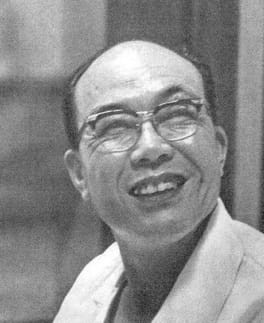
Photo: 財界研究社、撮影者不明 / Public domain (source: Wikimedia Commons)
My Take
I love that Honda started as a grease-stained kid in a Shizuoka repair shop and basically refused to let school certificates tell him what he could build. There's something gloriously stubborn about a guy whose whole motto was "don't imitate" and who, when his team wanted to play it safe, instead declared they'd go win the Isle of Man TT and then actually pulled it off. He famously hurled wrenches when he was furious, yet handed the entire business to Takeo Fujisawa so he could stay where his heart was: on the floor, obsessing over engines. To me that's the dream version of a maker, someone who treats a Super Cub and a clean-emissions engine with equal reverence. He's loud, human, impatient, and weirdly inspiring. Most "visionaries" bore me; this one I'd actually want to grab a beer with.
This take was written by generative AI, one per person, from publicly reported facts (editorial policy). It is a reading of the record, not reporting.
Story
Overview
Soichiro Honda (November 17, 1906 – August 5, 1991) was a Japanese entrepreneur and engineer born in Mitsuo Village, Iwata District, Shizuoka Prefecture (present-day Tenryu Ward, Hamamatsu). After apprenticing at a Tokyo auto-repair shop, he struck out independently in 1928 and founded Honda Motor Co., Ltd. in 1948, serving as its president until 1973. Under his technical leadership, Honda swept positions 1 through 5 in the 125 cc and 250 cc classes at the Isle of Man TT in 1961 and introduced the CVCC engine in 1972 — the world's first to comply with the stringent U.S. Muskie Act emissions standards — cementing the company's reputation as a global technology leader.
1. Profile
- Name (English)
- Soichiro Honda
- Name (Japanese)
- 本田宗一郎
- Reading
- ほんだ そういちろう
- Born
- November 17, 1906 – August 5, 1991
- Origin
- Mitsuo Village, Iwata District, Shizuoka Prefecture, Japan (present-day Tenryu Ward, Hamamatsu)
- Occupation
- Entrepreneur / Engineer / Automobile and Motorcycle Developer
- Zodiac / Chinese zodiac
- Scorpio / Horse
- Agency history
- Honda Motor Co., Ltd. — Representative Director and President (1948–1973)
Honda Motor Co., Ltd. — Director and Supreme Advisor (c. 1973–1983) - Active years
- 1928–1991
2. Background
- Elementary school
- Futamata Town Futamata Ordinary Higher Elementary School (present-day Hamamatsu City Futamata Elementary School) — graduated
- High school
- Did not advance to high school
- University
- Hamamatsu Higher Technical School (present-day Faculty of Engineering, Shizuoka University) — auditor (not a formal enrolled student)
- Debut
- 1928 — opened the Hamamatsu branch of Tokyo Art Shokai independently, engaging in automobile repair
Awards & achievements
- 1952 — Blue Ribbon Medal (Japan)
- 1980 — Holley Medal, American Society of Mechanical Engineers
- 1981 — Order of the Sacred Treasure, First Class (Japan)
- 1987 — UNEP Global 500 Award
- 1989 — Inducted into the Automotive Hall of Fame (USA) — first Asian inductee
- 1990 — FIA Gold Medal
- 1991 — Junior First Rank and Order of the Rising Sun, Paulownia Flowers with Grand Cordon (posthumous)
- 1994 — Japan Automotive Hall of Fame inductee
Timeline
- 1906Born on November 17 in Mitsuo Village, Iwata District, Shizuoka Prefecture (present-day Tenryu Ward, Hamamatsu)
- 1922Moved to Tokyo and entered apprenticeship at Tokyo Art Shokai, an automobile repair shop in Yushima
- 1928Opened the Hamamatsu branch of Tokyo Art Shokai independently
- 1934Founded Tokai Seiki Heavy Industry (later Tokai Seiki)
- 1935Married Sachi Isobe
- 1948Founded Honda Motor Co., Ltd. and became its representative director
- 1954Declared Honda's entry into the Isle of Man TT Race, driving technical advancement
- 1961Honda swept positions 1–5 in both the 125 cc and 250 cc classes at the Isle of Man TT
- 1972Announced the CVCC engine — the world's first to meet the strict U.S. Muskie Act emissions standards
- 1973Retired as president at age 67; became director and supreme advisor
- 1989Inducted into the Automotive Hall of Fame (USA) — first Asian to receive the honor
- 1991Died on August 5 at age 84 from liver failure
3. Relationships
- Spouse
- Sachi Isobe (married 1935)
- Children
- 3 children: eldest son Hirotoshi, second son Katsuhisa, eldest daughter Keiko
4. Personality
Hobbies
- Interest in aviation and aircraft
- Appreciation of painting
Specialties
- Engine design and development
- Metalworking
Motto
"Do not imitate others." / "Nothing is born from a person without dreams."
5. Works & records
Filmography / notable works
| Category | Title | Role | Year |
|---|---|---|---|
| Book | Ore no Kangae (My Thoughts) | Author | 1963 |
| Book | Yume wo Chikara ni: Watashi no Rirekisho (Turning Dreams into Strength: My Personal History) | Author | 1986 |
| Product / Development | Dream (Honda Motor Co.'s first in-house motorcycle) | Development lead | 1949 |
| Product / Development | Super Cub C100 | Development lead | 1958 |
| Product / Development | Honda S500 (Honda's first four-wheeled passenger car) | Development lead | 1963 |
| Product / Development | CVCC Engine (world's first Muskie Act-compliant engine) | Development lead | 1972 |
6. Links
- Wikipedia (Japanese)https://ja.wikipedia.org/wiki/%E6%9C%AC%E7%94%B0%E5%AE%97%E4%B8%80%E9%83%8E
- Wikidatahttps://www.wikidata.org/wiki/Q313304
7. About this entry
Tags
- Last updated
Facts are limited to publicly available information up to 2024; non-public or unconfirmed items are omitted. English text is machine-assisted (facts translated by Sonnet, "My Take" written by Opus 4.8). The Japanese page is the source of record.
Frequently asked questions
When was Soichiro Honda born?
Born November 17, 1906.
When did Soichiro Honda die?
Died August 5, 1991, aged 84.
Where was Soichiro Honda from?
Soichiro Honda was from Mitsuo Village, Iwata District, Shizuoka Prefecture, Japan (present-day Tenryu Ward, Hamamatsu).
What did Soichiro Honda do?
Soichiro Honda worked as Entrepreneur, Engineer, Automobile and Motorcycle Developer.
When was Soichiro Honda active?
1928–1991.
What was Soichiro Honda known for?
Notable works include Ore no Kangae (My Thoughts), Yume wo Chikara ni: Watashi no Rirekisho (Turning Dreams into Strength: My Personal History), Dream (Honda Motor Co.'s first in-house motorcycle).