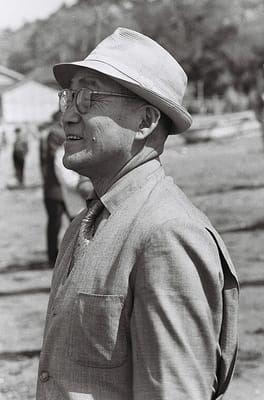
Photo: Yoshikatsu Kanno / Public domain (source: Wikimedia Commons)
My Take
You might not know his name, but trust me, you've felt his work: every time Godzilla's foot crashes down or Ultraman's beam lights up the screen, that's Eiji Tsuburaya. This guy from Sukagawa in Fukushima built entire miniature cities just to smash them with absolute conviction, and honestly that obsession kind of moves me. No computers, no shortcuts, just hands, patience, and a relentless question: how do I make this look real? I love that the quiet technician backstage turns out to be the biggest romantic in the room, taking pure imagination and forcing it into something physical you can almost touch. He passed in 1970, yet over half a century later kids are still gasping at monsters and flying heroes every week. The seeds he planted haven't withered one bit, and that's the mark of a real master.
This take was written by generative AI, one per person, from publicly reported facts (editorial policy). It is a reading of the record, not reporting.
Overview
Eiji Tsuburaya (1901–1970) was a Japanese cinematographer, film director, and television producer born in Sukagawa, Fukushima Prefecture. He is widely recognized as a pioneering figure in practical special effects and tokusatsu filmmaking in Japan. He attended Tokyo Denki University and built a career spanning film and early television production. He died on January 25, 1970, leaving a lasting legacy in the genre of science fiction and monster entertainment.
1. Profile
- Name (English)
- Eiji Tsuburaya
- Name (Japanese)
- 円谷英二
- Reading
- つぶらや えいじ
- Born
- July 7, 1901 – January 25, 1970
- Origin
- Sukagawa, Fukushima Prefecture, Japan
- Occupation
- Cinematographer / Television Producer / Film Director / Science Fiction Writer / Film Producer
- Zodiac / Chinese zodiac
- Cancer / Ox
2. Background
- University
- Tokyo Denki University
3. Links
4. About this entry
Tags
- Last updated
Only publicly available facts are listed; non-public or unconfirmed items are omitted. Base data was compiled from Wikidata from June 2026 onward; ages are recalculated daily and deaths are checked against Wikidata on an ongoing basis. English text is machine-assisted (facts translated by Sonnet, "My Take" written by Opus 4.8). The Japanese page is the source of record.
Frequently asked questions
When was Eiji Tsuburaya born?
Eiji Tsuburaya was born on July 7, 1901.
When did Eiji Tsuburaya die?
Eiji Tsuburaya died on January 25, 1970, aged 68.
Where was Eiji Tsuburaya from?
Eiji Tsuburaya was from Sukagawa, Fukushima Prefecture, Japan.
What did Eiji Tsuburaya do?
Eiji Tsuburaya worked as Cinematographer, Television Producer, Film Director, Science Fiction Writer, Film Producer.
Where did Eiji Tsuburaya study?
Eiji Tsuburaya attended Tokyo Denki University.
Cinematographer — see all → · Television Producer — see all → · More people from Japan → · More people born on July 7 →