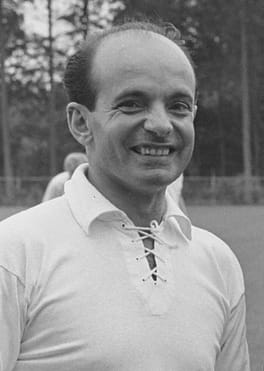
Photo: Eric Koch for Anefo / CC0 (source: Wikimedia Commons)
Born on April 4, 1925 in Dortmund, Province of Westphalia, Germany, Dettmar Cramer was an association football player, non-fiction writer and association football coach. Death is recorded on September 17, 2015, at the age of 90. Listed accolades include Medal of the Order of Merit of the Federal Republic of Germany. Dettmar Cramer was listed at 161 cm.
My Take
Dettmar Cramer is one of those figures who quietly shaped football history on multiple continents, and I find him endlessly fascinating. Born in Dortmund in 1925, this compact German coach somehow ended up being the single most important person in the development of Japanese football — earning the title "father of Japanese football" — before that was even a particularly cool thing to do. He also guided Bayern Munich to back-to-back European Cups in 1975 and 1976, which alone would cement most careers. But Cramer was always restless, always teaching, bouncing from Japan to Egypt to the United States at a time when no ambitious German coach felt any pressure to do that. He passed away in 2015, and I genuinely think the global football world underrates just how far his reach extended. A true football missionary in the best possible sense.
This take was written by generative AI, one per person, from publicly reported facts (editorial policy). It is a reading of the record, not reporting.
1. Profile
- Name (English)
- Dettmar Cramer
- Name (Japanese)
- デットマール・クラマー
- Reading
- でっとまーる・くらまー
- Born
- April 4, 1925 – September 17, 2015
- Origin
- Dortmund, Province of Westphalia, Germany
- Height
- 161 cm
- Occupation
- association football player / non-fiction writer / association football coach / coach
- Zodiac / Chinese zodiac
- Aries / Ox
2. Background
Awards & achievements
- Medal of the Order of Merit of the Federal Republic of Germany
3. Links
4. About this entry
Tags
- Last updated
Only publicly available facts are listed; non-public or unconfirmed items are omitted. Base data was compiled from Wikidata from June 2026 onward; ages are recalculated daily and deaths are checked against Wikidata on an ongoing basis. English text is machine-assisted (facts translated by Sonnet, "My Take" written by Opus 4.8). The Japanese page is the source of record.
Frequently asked questions
When was Dettmar Cramer born?
Dettmar Cramer was born on April 4, 1925.
When did Dettmar Cramer die?
Dettmar Cramer died on September 17, 2015, aged 90.
Where was Dettmar Cramer from?
Dettmar Cramer was from Dortmund, Province of Westphalia, Germany.
What did Dettmar Cramer do?
Dettmar Cramer worked as association football player, non-fiction writer, association football coach, coach.
How tall was Dettmar Cramer?
Dettmar Cramer was 161 cm tall.
Association football player — see all → · Non-fiction writer — see all → · More people from Germany → · More people born on April 4 →