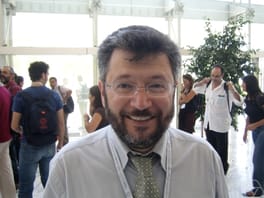
Photo: Gert Martin Greuel / CC BY-SA 2.0 de (source: Wikimedia Commons)
Efim Zelmanov, born on September 7, 1955 in Khabarovsk, Russia, is a mathematician and university teacher. That puts Efim Zelmanov at 71 years old in 2026. Education on record includes Novosibirsk State University. Recorded honors include Fields medal (1994), honorary doctorate from the University of Alberta, honorary doctorate of the University of Oviedo and 2 more. Notable works include Burnside's problem.
My Take
Efim Zelmanov belongs to a rarer kind of celebrity, the sort who quietly rewrites what humanity knows. Born in Khabarovsk and trained at Novosibirsk State University, he climbed from the Russian Far East to the very summit of mathematics, winning a Fields Medal in 1994 for resolving the restricted Burnside problem, a question that had confounded the field for decades. The string of honorary doctorates that followed feels almost incidental next to that achievement. I am not a mathematician, but I do not need to follow the proof to feel awe. Minds that bend abstraction into truth deserve every bit of our respect.
This take was written by generative AI, one per person, from publicly reported facts (editorial policy). It is a reading of the record, not reporting.
1. Profile
- Name (English)
- Efim Zelmanov
- Name (Japanese)
- エフィム・ゼルマノフ
- Reading
- えふぃむ・ぜるまのふ
- Born
- September 7, 1955 (age 71)
- Origin
- Khabarovsk, Russia
- Occupation
- mathematician / university teacher
- Zodiac / Chinese zodiac
- Virgo / Goat
2. Background
- University
- Novosibirsk State University
Awards & achievements
- 1994 Fields medal
- honorary doctorate from the University of Alberta
- honorary doctorate of the University of Oviedo
- honorary doctor of the University of Chile
- 2019 honorary doctor of the University of Haute-Alsace
3. Works & records
Filmography / notable works
| Category | Title |
|---|---|
| Notable work | Burnside's problem |
4. Links
5. About this entry
Tags
- Last updated
Facts are limited to publicly available information up to 2024; non-public or unconfirmed items are omitted. English text is machine-assisted (facts translated by Sonnet, "My Take" written by Opus 4.8). The Japanese page is the source of record.
Frequently asked questions
When was Efim Zelmanov born?
Born September 7, 1955 (age 71).
Where is Efim Zelmanov from?
Efim Zelmanov is from Khabarovsk, Russia.
What does Efim Zelmanov do?
Efim Zelmanov works as mathematician, university teacher.
What is Efim Zelmanov known for?
Notable works include Burnside's problem.
Mathematician — see all → · University teacher — see all → · More people from Russia →