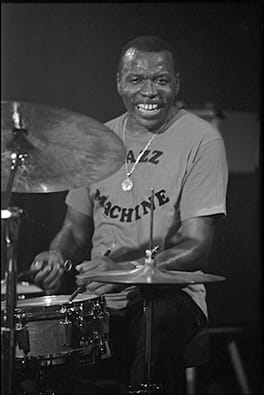
Photo: Thomas Huther / CC BY-SA 4.0 (source: Wikimedia Commons)
Elvin Jones was born on September 9, 1927 in Pontiac, Michigan, United States and was credited as a jazz drummer, recording artist and jazz musician. Death is recorded on May 18, 2004, at the age of 76. Recorded honors include NEA Jazz Masters.
My Take
Elvin Jones is one of those musicians where you don't just hear the drums — you feel them in your chest. Growing up in Pontiac, Michigan, he eventually landed in John Coltrane's legendary quartet, and what happened there between 1960 and 1965 was something genuinely unrepeatable. Albums like A Love Supreme and Live at Birdland show a drummer who wasn't keeping time so much as sculpting it — rolling polyrhythms, overlapping accents, a conversation happening across the whole kit at once. He wasn't background; he was an equal voice. After the Coltrane years he led his own groups for decades, mentoring a new generation under the Jazz Machine banner, and earned NEA Jazz Masters recognition along the way. When he passed in May 2004, jazz lost a force of nature. The recordings he left behind still make drummers stop whatever they're doing and just listen.
This take was written by generative AI, one per person, from publicly reported facts (editorial policy). It is a reading of the record, not reporting.
1. Profile
- Name (English)
- Elvin Jones
- Name (Japanese)
- エルビン・ジョーンズ
- Reading
- えるびん・じょーんず
- Born
- September 9, 1927 – May 18, 2004
- Origin
- Pontiac, Michigan, United States
- Occupation
- jazz drummer / recording artist / jazz musician / drummer / musician
- Zodiac / Chinese zodiac
- Virgo / Rabbit
2. Background
Awards & achievements
- NEA Jazz Masters
3. Links
- Official sitehttps://www.elvinjones.com/
- Wikipedia (English)https://en.wikipedia.org/wiki/Elvin%20Jones
- Wikipedia (Japanese)https://ja.wikipedia.org/wiki/%E3%82%A8%E3%83%AB%E3%83%B4%E3%82%A3%E3%83%B3%E3%83%BB%E3%82%B8%E3%83%A7%E3%83%BC%E3%83%B3%E3%82%BA
- Wikidatahttps://www.wikidata.org/wiki/Q357179
4. About this entry
Tags
- Last updated
Only publicly available facts are listed; non-public or unconfirmed items are omitted. Base data was compiled from Wikidata from June 2026 onward; ages are recalculated daily and deaths are checked against Wikidata on an ongoing basis. English text is machine-assisted (facts translated by Sonnet, "My Take" written by Opus 4.8). The Japanese page is the source of record.
Frequently asked questions
When was Elvin Jones born?
Elvin Jones was born on September 9, 1927.
When did Elvin Jones die?
Elvin Jones died on May 18, 2004, aged 76.
Where was Elvin Jones from?
Elvin Jones was from Pontiac, Michigan, United States.
What did Elvin Jones do?
Elvin Jones worked as jazz drummer, recording artist, jazz musician, drummer, musician.
Recording artist — see all → · More people from the United States → · More people born on September 9 →