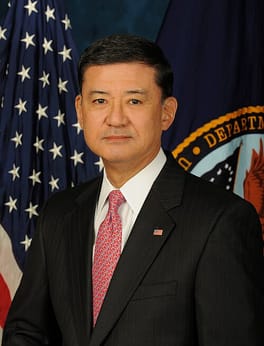
Photo: US Department of Veterans Affairs / Public domain (source: Wikimedia Commons)
Eric Ken Shinseki was born on November 28, 1942 in Līhuʻe, Hawaii, United States and is credited as a politician and military commander. As of 2026, Eric Ken Shinseki is 83 years old. Education on record includes Kauai High School and Duke University. Recorded honors include Bronze Star Medal, Legionnaire of Legion of Merit, Purple Heart and 1 more.
My Take
Eric Shinseki is one of those figures who quietly made history in ways that only become clear in hindsight. Growing up in Līhuʻe, Hawaii, the son of Japanese American families who lived through the internment era, he went on to become a four-star general and the first Asian American to serve as Chief of Staff of the U.S. Army — and he earned his Purple Heart and Bronze Star in Vietnam, losing part of his foot to a land mine without stepping back from his career. What I respect most is the 2003 moment when he told Congress that occupying Iraq would require "several hundred thousand" troops, directly contradicting Rumsfeld's line — and was quietly pushed out for it. History proved him right. Then Obama tapped him to run Veterans Affairs, a thankless bureaucratic slog he took on with genuine intention. A man of uncommon integrity who paid real prices for telling the truth.
This take was written by generative AI, one per person, from publicly reported facts (editorial policy). It is a reading of the record, not reporting.
1. Profile
- Name (English)
- Eric Ken Shinseki
- Name (Japanese)
- エリック・シンセキ
- Reading
- えりっく・しんせき
- Born
- November 28, 1942 (age 83)
- Origin
- Līhuʻe, Hawaii, United States
- Occupation
- politician / military commander
- Zodiac / Chinese zodiac
- Sagittarius / Horse
2. Background
- High school
- Kauai High School
- University
- Duke University
Awards & achievements
- Bronze Star Medal
- Legionnaire of Legion of Merit
- Purple Heart
- Air Medal
3. Links
4. About this entry
Tags
- Last updated
Only publicly available facts are listed; non-public or unconfirmed items are omitted. Base data was compiled from Wikidata from June 2026 onward; ages are recalculated daily and deaths are checked against Wikidata on an ongoing basis. English text is machine-assisted (facts translated by Sonnet, "My Take" written by Opus 4.8). The Japanese page is the source of record.
Frequently asked questions
When was Eric Ken Shinseki born?
Eric Ken Shinseki was born on November 28, 1942 and is 83 years old.
Where is Eric Ken Shinseki from?
Eric Ken Shinseki is from Līhuʻe, Hawaii, United States.
What does Eric Ken Shinseki do?
Eric Ken Shinseki works as politician, military commander.
Where did Eric Ken Shinseki study?
Eric Ken Shinseki attended Duke University.
Politician — see all → · More people from the United States → · More people born on November 28 →